
News
Santa’s high-performance sleigh


By Sean Moriarty
Motorists in the market for a new car in January might want to pay attention to the performance levels of Santa’s sleigh.
The big man in red has just 36 hours to play with, beginning in New Zealand late on Christmas Eve, Irish time
By the time he has visited Killarney a few hours later he will have just over half his journey completed. His work won’t be done until the early hours of St Stephen’s Day, his last port of call is Alaska, which is very near his North Pole base.
In total, Santa needs to travel 10 million kilometres in that 36 hour time frame. That means he will travel the world at a speed of 77 kilometres per second! This proves why he cannot be seen, as 77 kilometres per second is, after-all, 3,000 times the speed of sound.
But if Santa can’t be seen, it is possible, just about, to hear him because the speed he is travelling at means he, the sleigh and team of reindeer are giving off a sonic boom every couple of micro-seconds…listen very closely and it may be just possible to hear the boom.
Apart from the performance of the sleigh, Santa is a very busy man during the early hours of Christmas morning and his own level of fitness could make him a serious contender for a place on the Kerry team.
There are close to seven billion homes in the world, that gives him 130 microseconds to park the sleigh on the roof, climb down a chimney, place the presents under the tree and eat the treat left out for him. Phew! How does he do that without getting very tired?
That is easy to explain. Santa is known for his generosity. And you know what they say about generous people – they have very big hearts! Santa’s heart is a lot more powerful than any normal human being and that is one of his secrets.
That said, it is understandable why Santa needs an extra-long rest and is rarely seen anywhere in the world between Christmas Day and the following December when he starts to make his naughty or nice list again.



Grady demands Killarney traffic review
Killarney councillor Martin Grady has called for an urgent review of traffic management across the town following severe delays along...


Killarney Pumpkin Farm returns for Halloween
The annual event is in its sixth year and caters to people of all ages. The farm is located in...


Killarney Toastmasters host special open night
Killarney Toastmasters is inviting members of the local community to an open night at the Dromhall Hotel on Muckross Road...

Killarney hotels achieve top global rankings in Readers’ Choice Awards
Killarney hotels achieve top global rankings in Readers’ Choice Awards Two leading Killarney hotels are celebrating major international accolades following...

Paralympic legend Jason Smyth visits St Brendan’s
Paralympic legend Jason Smyth visits St Brendan’s World renowned Paralympian and world record holder Jason Smyth paid a visit to...
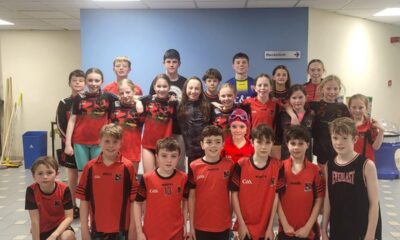

Fossa Swimmers make a splash at County Finals
The Fossa Swim team pictured at the Tralee Sports Complex following their successful outing at the County Finals of the...

On the Ball Part 2 of the Mikey Daly Interview
Éamonn Fitzgerald EF: Killarney Celtic are invited to participate in an Irish competition. That has big financial implications for travel,...


LUKE MANGAN recently caught up with Kerry FC’s manager, Colin Healy.
He spoke to him about his careers as a player and manager. Here’s how it went: When you began your...


Home cup tie for St Paul’s could be epic
Paudie O’Connor National Cup (Round 1) Utility Trust St Paul’s v GCU Brunell Saturday 7.30pm Killarney Sports and Leisure Centre...


Chances of Kerry v Cork Munster final in 2026 decrease as Munster GAA delay seeding plan
After facing a backlash from Limerick, Clare, Waterford and Tipperary players, Munster GAA have postponed their plan to keep Cork...
