
News
More money, more problems


By Michael O’Connor
This week, the Central Bank eased their lending limits to allow first-time buyers to borrow up to four times their income, an increase from 3.5 times set in place following the housing bubble fiasco of 2008.
I appreciate that for those looking to buy a house in the current market, this represents an opportunity to finally get on the property ladder and is welcome support.
However, the reality is, it is these extended credit facilities that have driven house prices higher over the last 30 years. Creating financial mechanisms to allow home buyers to tie themselves to more and more debt is not the solution that is needed.
Imaginary Wealth
Wage increases are not the factor driving the housing market to 'unaffordable' prices. Our new-found ability to justify these surging prices is thanks to some banking wizardry.
Longer mortgage terms and lower and lower interest rates have ensured that monthly payments are as affordable as they have ever been.
Yes, €500,000 is a sizeable mortgage, but if you spread it out over 35 years at historically low-interest rates, suddenly it seems justifiable, manageable even. The bidder most willing to shackle themselves to this life sentence 'wins'.
But what happens as interest rates rise? The very thing we thought we could afford is no longer affordable as the terms of the deal change.
All this credit in the system stops working when the cost to borrow starts to increase. We no longer can afford the things we thought we could afford. The imaginary wealth we thought we had, disappears.
And yet the solution from the Central Bank is to allow more leverage in the system in a rising interest rate environment.
Can't afford a home?
Not to worry, we will just lend you more money so we can prop up this house of cards just a little longer.
Pumping more money into an already inflationary environment does the exact opposite of what is needed. Instead of addressing supply issues and regulatory issues, they continue to focus on mechanisms to help justify current prices.
The Root of the Problem
Increasing the leverage in the system just kicks the can down the road. Currently, the data shows that home sales are slowing dramatically in the face of higher interest rates and a slowing economy. We are in the middle of a stand off between buyers and sellers. Buyers who can't afford to purchase at current prices as interest rates rise and sellers who don't want to sell at a price lower than their neighbour sold for.
Instead of leaving the market dynamics of supply and demand play out, allowing some downward pressure on house prices, the Central Bank has thrown a bone to sellers and disguised it as a benefit for buyers. They hope that this attempt to 'help' buyers stretch just a little further will be enough to keep the wheels turning. It won't.
Once Again
Allowing more leverage in the system to help justify higher and higher prices is not the answer. Doing it in the face of inevitably higher interest rates is simply thoughtless.
We simply didn't build enough homes following the last housing crash to meet the demand coming from millennials reaching their household formation years.
Perhaps addressing this generationally undersupply would be a more worthwhile endeavour instead of extending lines of credit, the very thing that facilitated this price surge in the first place.
Just a thought.
To learn what companies to invest in, and for direct access to my personal investment portfolio, go to www.theislandinvestor.com.

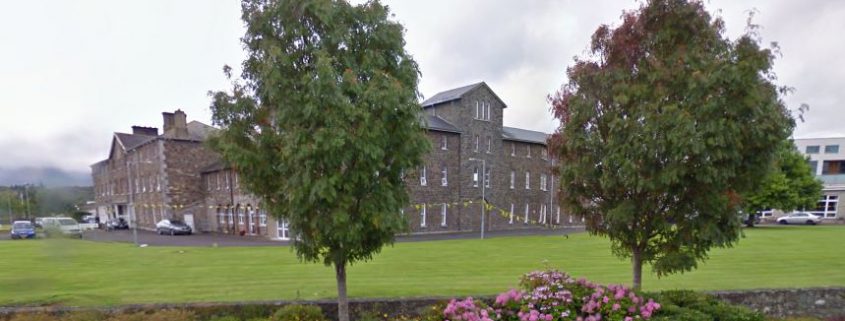
A design team has been appointed to advance plans for the proposed Minor Injury Unit on the grounds of St Columbanus Home though the HSE has confirmed it cannot yet give a construction or opening timeline.
Fianna Fáil TD Deputy Michael Cahill received the update in response to a Parliamentary Question submitted to the Minister for Health. HSE South West confirmed the newly appointed team will progress the project through design development, planning, and regulatory approval following the transfer of residents to the new Killarney Community Nursing Unit.
Deputy Cahill welcomed the appointment of the design team but raised concerns over the lack of a definitive schedule.
“I welcome the appointment of a design team, which represents progress towards delivering this important facility. However, I am concerned that the HSE is still unable to provide a definitive timeline. Previous indications from HSE officials pointed towards construction commencing in 2026, with completion anticipated in 2027. We now need clarity on the project schedule and assurances that there will be no unnecessary delays,” Deputy Cahill said.
He noted that the facility is vital to serve Killarney and the wider east, mid, and south Kerry regions while relieving pressure on the Emergency Department at University Hospital Kerry.
The HSE also confirmed it is finalising a broader review of healthcare accommodation across Killarney to develop the St Columbanus campus as an integrated healthcare hub.
“As a member of the Oireachtas Joint Committee on Health, I will continue to press the HSE and the Minister for Health to ensure this project is progressed without further delay. People across Killarney, east, mid, west and south Kerry deserve certainty. The appointment of a design team is welcome but the next priority must be getting this project to construction and delivering the facility,” Deputy Cahill concluded.
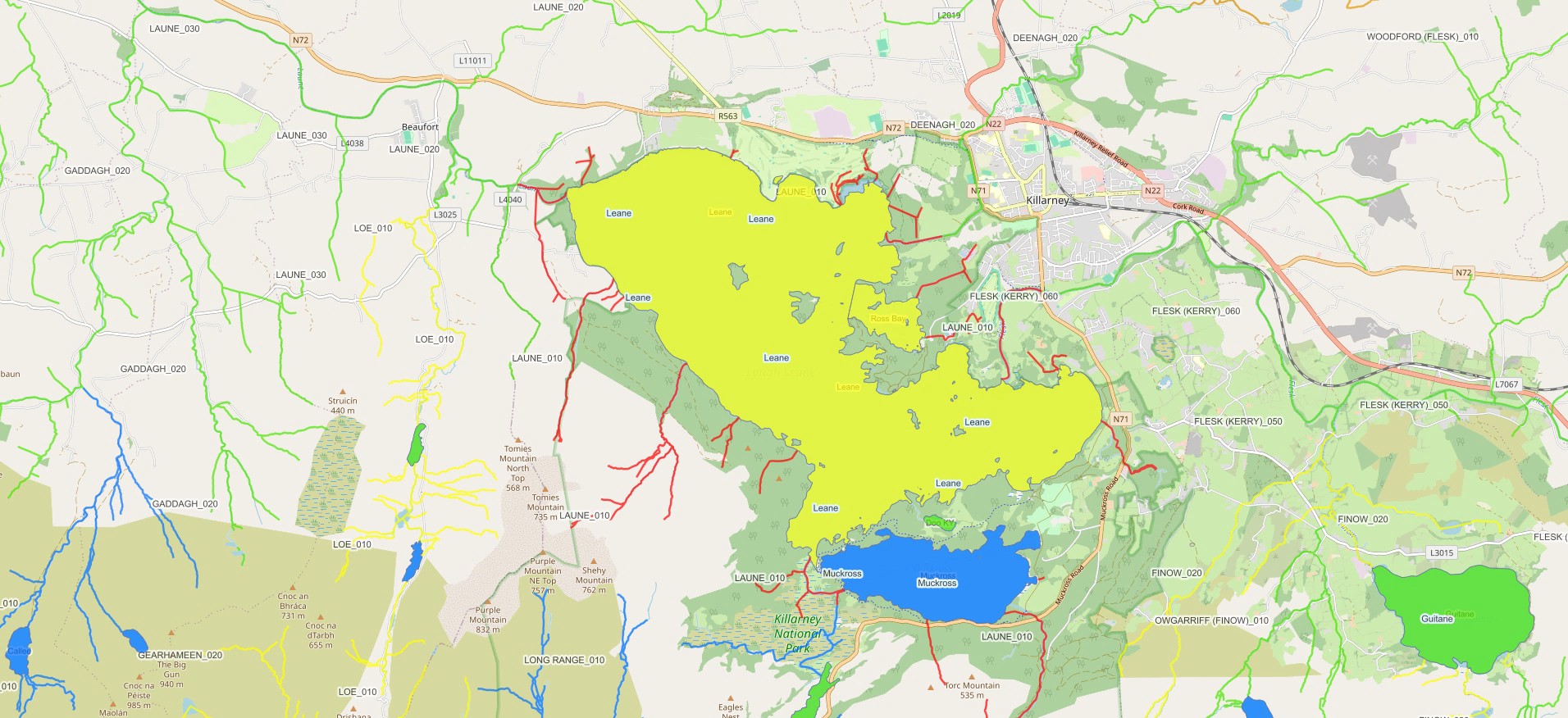
Lochanna Beo’s mapping highlights water quality concerns
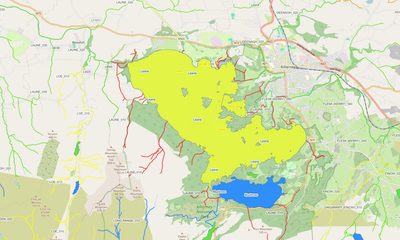
Local environmental action group Lochanna Beo has released mapping data from the Environmental Protection Agency (EPA) to draw attention to deteriorating water quality across Killarney and the broader Laune Catchment.
The EPA map uses a colour-coded system to rate water quality status from 2019 to 2024: blue indicates high status, green indicates good, yellow represents moderate, brown denotes poor, and red signifies bad status.
The figures indicate significant ecological pressure on local lakes and rivers compared to neighbouring areas across County Kerry.
Formed during the summer of 2026, Lochanna Beo aims to bring together residents, business owners, agricultural operators, and public bodies to address the key factors affecting the regional aquatic ecosystem.
The community initiative is seeking direct engagement with relevant statutory authorities to implement practical restoration measures and protect the long-term health of Killarney’s water bodies.

Design team appointed for injury unit
A design team has been appointed to advance plans for the proposed Minor Injury Unit on the grounds of St...

Lochanna Beo’s mapping highlights water quality concerns
Lochanna Beo’s mapping highlights water quality concerns Local environmental action group Lochanna Beo has released mapping data from the Environmental...


Stefan Caulfield-Dreier signs professional cycling contract
Former Killarney Cycling Club rider Stefan Caulfield-Dreier has secured a professional contract with leading Dutch-based outfit Azerion-Villa Valkenburg. The 23-year-old...


Church seeks creative Christmas trees for festival
Church seeks creative Christmas trees for festival The Methodist Church in Killarney is inviting local schools, community groups, businesses, and...


€6,000 Scrooge Giveaway!
€6,000 Scrooge Giveaway! Six lucky audience members will each walk away with €1,000 as the Gleneagle Arena welcomes an extraordinary...
