
News
Should I Buy the Dip?

So many people presume they will know what to do when a correction comes. I wish it were that easy.
Hindsight is 20/20, and everything looks obvious after the fact. But I can tell you from first-hand experience. It’s nearly impossible to swing for the fences and buy up the significant dips when everything is burning around you.
Take the pandemic as an example. In March 2020, companies that I held, and had positive conviction in, fell 50%. It’s easy to look back now and see that these were buying opportunities, but committing capital to a company as it craters is testing for even the most unwavering Stalwart.
The narrative upon which you initially invested has now completely changed.
Nothing is obvious.
When the economy comes to a standstill, the world grounds to a halt, commodity markets fall apart, policymakers are changing the rules, and the government needs to step in to shore up the Fixed Income market. Will you be able to set aside emotion and dive in headfirst?
They say you learn from experience, and for me, my lack of a clear analytical checklist left me in a state of decision paralysis. Lesson learned.
Create your Checklist
Most of us mere mortals can’t separate logic from emotion in the heat of the moment, so make sure you set out some rules to guide you through those clouded moments.
You can think of your emotional state and the ability to make good decisions as sitting on opposite sides of a seesaw. If your state of emotional arousal is high, your capacity to decide well is low. A checklist helps take out the emotion and moves you toward a proper choice. It also keeps you from succumbing to decision paralysis.
This checklist will be different for everyone, but here are some examples.
Does the company still hold a competitive advantage?
Is this correction macro-led or idiosyncratic? - is this just contagion effects from a market-wide sell-off, or is this a company-specific correction?
Has the growth outlook for the company dramatically changed?
Is this an earnings or non-earnings event? For example, did the stock fall off the back of a disappointing quarterly earnings call, or is this a non-earnings-related correction? There will always be some added volatility during each earnings season, so it is important to make the distinction.
Analyze the value indicators of the company - Is the company competitively priced relative to others in its sector? This is done by measuring the key metrics (P/E, P/S, FCF, etc.) against the company’s competitors.
Analyze the momentum indicators for the company – 200-day moving average, MACD, RSI, Support and Resistance levels. These technical indicators will help you establish when the stock is overbought or oversold.
Analyze the quality indicators for the company - Compare Free cash flow metrics, Cash Flow Return on Equity figures, ROIC, Gross Profits and EPS stability relative to competitors
If these metrics remain strong, so too should your conviction.
No Shortcuts
Some of these terms may be new to you, but you need to know them if you are looking to be a successful stock picker over the long term. Buying stocks simply because they have fallen and you expect them to mean revert is a recipe for disaster.
More than 40% of all companies that were ever in the Russell 3000 Index experienced a “catastrophic stock price loss”, which we define as a 70% decline from peak levels which is not recovered.
Don’t just assume these stocks will come back. Many of them don’t. You have a much greater probability of picking a mega loser than a mega winner.
“While the most successful companies generated massive wealth over the long run, only around 10% of all stocks since 1980 met the definition of “mega winners”.
It’s perfectly ok to be a contrarian, but be a well-informed contrarian, don’t just blindly follow the stock down. The odds are not in your favour.
With the new year just around the corner, take some time to set out your investment plan and checklist for the coming year. Fortune favours the prepared.
As always, you can find more investing information at theislandinvestor.com


A design team has been appointed to advance plans for the proposed Minor Injury Unit on the grounds of St Columbanus Home though the HSE has confirmed it cannot yet give a construction or opening timeline.
Fianna Fáil TD Deputy Michael Cahill received the update in response to a Parliamentary Question submitted to the Minister for Health. HSE South West confirmed the newly appointed team will progress the project through design development, planning, and regulatory approval following the transfer of residents to the new Killarney Community Nursing Unit.
Deputy Cahill welcomed the appointment of the design team but raised concerns over the lack of a definitive schedule.
“I welcome the appointment of a design team, which represents progress towards delivering this important facility. However, I am concerned that the HSE is still unable to provide a definitive timeline. Previous indications from HSE officials pointed towards construction commencing in 2026, with completion anticipated in 2027. We now need clarity on the project schedule and assurances that there will be no unnecessary delays,” Deputy Cahill said.
He noted that the facility is vital to serve Killarney and the wider east, mid, and south Kerry regions while relieving pressure on the Emergency Department at University Hospital Kerry.
The HSE also confirmed it is finalising a broader review of healthcare accommodation across Killarney to develop the St Columbanus campus as an integrated healthcare hub.
“As a member of the Oireachtas Joint Committee on Health, I will continue to press the HSE and the Minister for Health to ensure this project is progressed without further delay. People across Killarney, east, mid, west and south Kerry deserve certainty. The appointment of a design team is welcome but the next priority must be getting this project to construction and delivering the facility,” Deputy Cahill concluded.
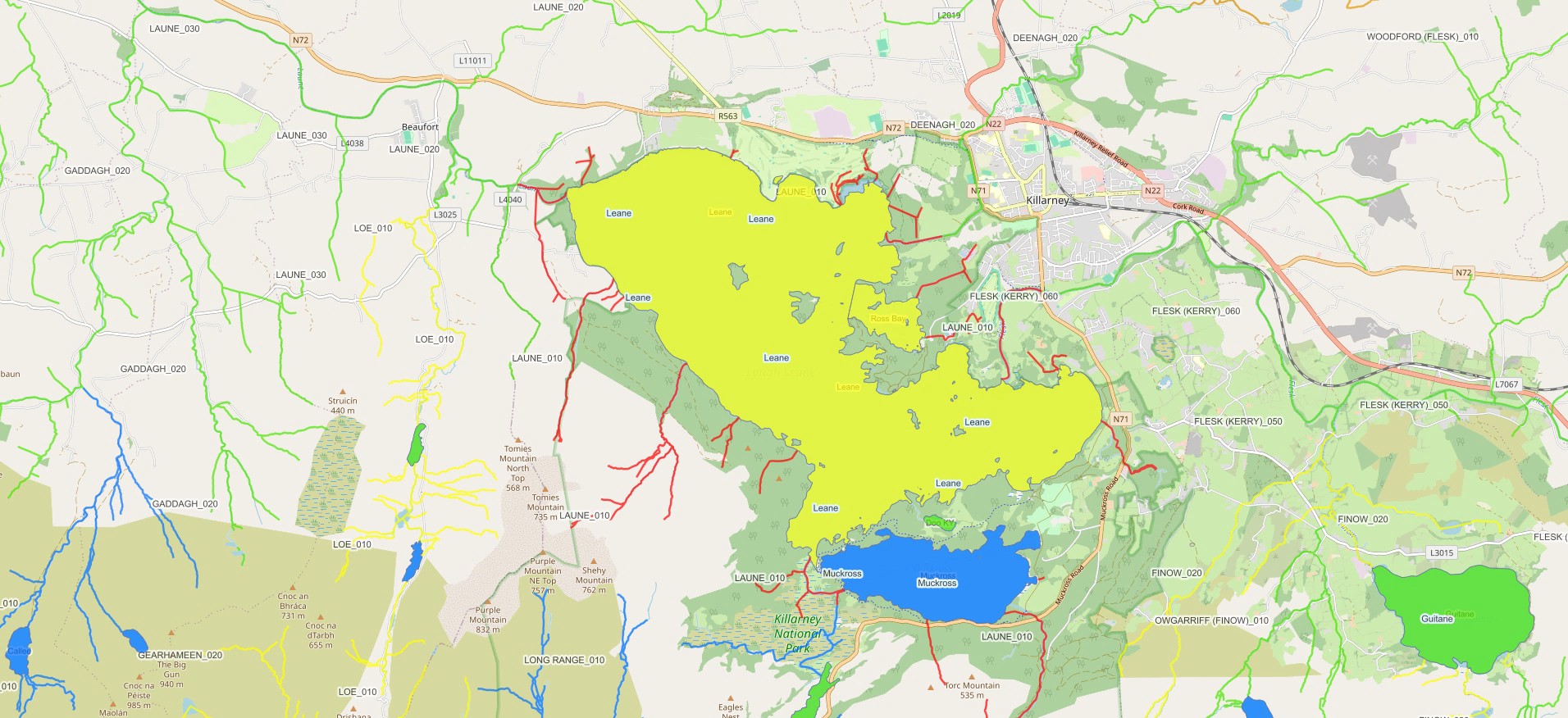
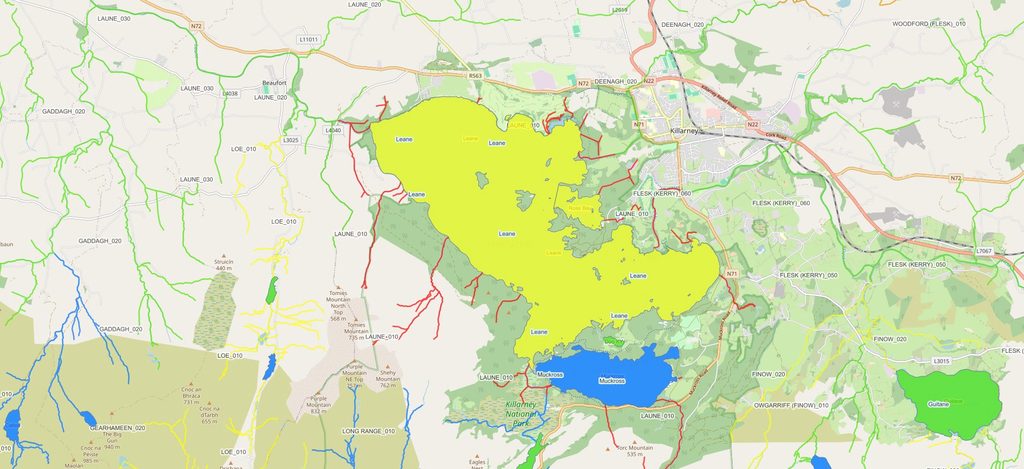
Lochanna Beo’s mapping highlights water quality concerns
Local environmental action group Lochanna Beo has released mapping data from the Environmental Protection Agency (EPA) to draw attention to deteriorating water quality across Killarney and the broader Laune Catchment.
The EPA map uses a colour-coded system to rate water quality status from 2019 to 2024: blue indicates high status, green indicates good, yellow represents moderate, brown denotes poor, and red signifies bad status.
The figures indicate significant ecological pressure on local lakes and rivers compared to neighbouring areas across County Kerry.
Formed during the summer of 2026, Lochanna Beo aims to bring together residents, business owners, agricultural operators, and public bodies to address the key factors affecting the regional aquatic ecosystem.
The community initiative is seeking direct engagement with relevant statutory authorities to implement practical restoration measures and protect the long-term health of Killarney’s water bodies.


Design team appointed for injury unit
A design team has been appointed to advance plans for the proposed Minor Injury Unit on the grounds of St...

Lochanna Beo’s mapping highlights water quality concerns
Lochanna Beo’s mapping highlights water quality concerns Local environmental action group Lochanna Beo has released mapping data from the Environmental...


Stefan Caulfield-Dreier signs professional cycling contract
Former Killarney Cycling Club rider Stefan Caulfield-Dreier has secured a professional contract with leading Dutch-based outfit Azerion-Villa Valkenburg. The 23-year-old...


Church seeks creative Christmas trees for festival
Church seeks creative Christmas trees for festival The Methodist Church in Killarney is inviting local schools, community groups, businesses, and...


€6,000 Scrooge Giveaway!
€6,000 Scrooge Giveaway! Six lucky audience members will each walk away with €1,000 as the Gleneagle Arena welcomes an extraordinary...


Fossa Swimmers make a splash at County Finals
The Fossa Swim team pictured at the Tralee Sports Complex following their successful outing at the County Finals of the...


On the Ball Part 2 of the Mikey Daly Interview
Éamonn Fitzgerald EF: Killarney Celtic are invited to participate in an Irish competition. That has big financial implications for travel,...


LUKE MANGAN recently caught up with Kerry FC’s manager, Colin Healy.
He spoke to him about his careers as a player and manager. Here’s how it went: When you began your...


Home cup tie for St Paul’s could be epic
Paudie O’Connor National Cup (Round 1) Utility Trust St Paul’s v GCU Brunell Saturday 7.30pm Killarney Sports and Leisure Centre...


Chances of Kerry v Cork Munster final in 2026 decrease as Munster GAA delay seeding plan
After facing a backlash from Limerick, Clare, Waterford and Tipperary players, Munster GAA have postponed their plan to keep Cork...
