
News
KNOW YOUR RIGHTS: Deposits for private rented accommodation


In today’s property market, finding rented accommodation that is affordable is particularly challenging.
With a limited supply of rented property available and huge demand, finding somewhere to rent can be a stressful experience. The pressure is on to try to secure a place to live by putting down a deposit as quickly as possible. Before parting with any money though, and to avoid becoming a victim of rental scammers you should:
Always visit the property – don’t agree to rent it through a website or social media
Never transfer funds electronically to someone claiming to be an agent/landlord until you are sure you have a legitimate transaction
Check that the keys work and that you have full and correct contact details for the landlord/agent who is authorised to rent the property.
You should never hand over a deposit to a prospective landlord/agent until you are sure that you are happy with the condition of the property, the terms and conditions of the letting and are willing to rent it.
Holding deposits
Some landlords or agents may ask you for a holding deposit when you decide to take the accommodation. This is a sum of money you pay to hold the property before you sign the lease and enter into a contract with the landlord. You should always get a written receipt for a holding deposit.
Holding deposits are often not refundable if you don’t take up the accommodation. As a tenancy has not been created, it is not possible to avail of the Residential Tenancies Board dispute resolution to try to get back your money. You may be able to pursue the matter through the Small Claims Court.
Security deposits
You will be asked for a security deposit before moving into the accommodation. The landlord holds this deposit as security to cover any rent arrears, bills owing or damage beyond normal wear and tear at the end of the tenancy.
You cannot be forced to make upfront payments of more than two month’s rent. This includes a deposit of a month’s rent and one month’s rent in advance. This restriction applies to all tenancies created from 9 August 2021 and is set out in the Residential Tenancies (No. 2) Act 2021.
You should get a receipt for any deposit you pay. Your rent book should state how much of a deposit you paid.
Student Accommodation
Students in student-specific tenancies can opt-out of this restriction and pay a larger upfront payment if they want. The Residential Tenancies Board has a guidance document about this legislation.
Help with the Deposit
If you are getting a Social Welfare payment and are unable to pay the deposit, the Department of Social Protection’s representative (formerly the Community Welfare Officer) may be able to help with paying a deposit under the Supplementary Welfare Allowance Scheme.
If you are in emergency homeless accommodation, your local authority may help with any deposit needed to get accommodation under the HAP scheme. You should contact the housing section of your local authority for further information on this.
Record of Condition at Start and End of Tenancy
When you move in, your landlord must provide you with an inventory of the contents of the property. You should keep a record of the condition of everything that is listed, taking photos if possible, and agree this in writing with your landlord.
Before leaving the property you should clean it thoroughly, remove all your possessions, dispose of all rubbish and take dated photos to show the condition in which it was returned. This will be very useful if you find that the landlord is reluctant to return your deposit and you need to take a case to the RTB. Ideally you should request to be present at a final inspection of the property with the landlord/agent.
Losing the Deposit
When you leave a property at the end of the agreed rental period or after giving the agreed notice, the landlord should return your security deposit, promptly and in full. However, if you leave before the end of the agreed period, the landlord may keep your deposit, even if you have given notice. It is also possible that you may also be liable for the amount of rent due until the end of the lease, depending on what is stated in the lease agreement.
You may lose some or all of your deposit if:
* You leave without giving proper notice, or leave before the end of a fixed-term lease
* You cause damage to the accommodation beyond normal wear and tear
* You leave with unpaid bills
* You leave with rent arrears
The landlord cannot hold your possessions against money you owe, but they can apply to the RTB if they feel that your deposit does not cover rent arrears or the cost of damage to the property.
Making a Complaint to the Residential Tenancies Board
If you believe that your landlord is unfairly withholding your deposit, you should request it in writing. If your landlord claims that there are bills/rent outstanding or damage to the property you should request proof. If you cannot reach agreement/secure the return of your deposit you can make a complaint to the RTB and opt for mediation or adjudication on the issue. Mediation is free. Adjudication costs €15 if you apply online and €25 if submitting a paper application.
Tenant Deposit Protection Scheme Pending
A point to note is that the Residential Tenancies (Amendment) Act 2015 provides for a tenancy deposit protection scheme, where the RTB would manage and hold deposits for tenants and landlords but these provisions are not yet in effect.
Call a member of the local Citizens Information team in Kerry on 0818 07 7860. The offices are staffed from Monday to Friday from 10am to 4pm. Alternatively you can email on tralee@citinfo.ie or log on to www.citizensinformation.ie for further information.


WEEK 14
Felicity’s Summer in Killarney

Previously: Here on Dundag it was far easier to relax than anywhere else. They had a picnic blanket, some cold drinks and what felt like all the time in the world.
“I can’t believe I leave on Monday” Felicity said tiredly.
“Neither can I. This summer has flown. Tell me you have plans to come back sometime soon though? I don’t think Sheila and I can be as good of a mischief-making duo as me and you.”
Felicity had already spoken with her parents about her return to Killarney. “I’d like to come back for Halloween. Who knows, with my apprenticeship you may be seeing a lot more of me.”
Felicity glanced at Jack, who was looking far out over the lake. “That wouldn’t be so bad.” He paused. “There’s loads of things to do in Kerry around Halloween. There are countless events and festivals in the surrounding towns and parishes.”
“That would be nice. I love Halloween, it would be great to see how ye do it down here.” A few years ago she and her friends had run a school scare event in Dublin, for TYs and above only. It had been some of the best fun they’d had in school together.
“It’s going to be really strange not having you just around the corner anymore. I’ve gotten so used to showing up at Sheila’s and you being there.”
Knowing that her friends were going to miss her so much made Felicity’s chest twist. She knew that Auntie Sheila wasn’t looking forward to her leaving either. “At least I’ll be back soon. You’ll be seeing me off of the train before you can blink.”
“Yeah, I can’t wait.”
A few hours passed before Felicity and Jack returned to Hedgerow Place. Jack dropped her off at the door, promising to meet her at the bus station tomorrow to see her off. Felicity trudged towards the door morosely.
Auntie Sheila met her on the other side with a sad smile. “Hopefully you’ll be back soon poppet. I suppose for now you should probably pack.”
Felicity nodded and made her way upstairs. She entered the spare room , her room now, really. Auntie Sheila had offered her it permanently if she were to get her apprenticeship. That would be a dream come true, to live in Killarney and have something as exciting as an apprenticeship to work on.
Felicity packed slowly. She let herself daydream about what her life could look like, and how easy it would be to sink into it. Thoughts of coming back here, to a room that was fully hers circled around her head. Felicity looked around her room as she slowly progressed towards fitting her whole summer into just the two small suitcases and backpack that she had come to Killarney with.
It felt like her experiences were too big, too meaningful to pack away with her. Too much had happened this summer to pack it all away. The only solace, Felicity thought, was that she had to go so that she could come back again.
The Bus
Now she was standing once more at Killarney Bus Station, waiting to get the Expressway back to Cork before the next leg to Dublin. Auntie Sheila and Jack both stood nearby waiting to see her off.
Felicity had spent the last few days packing, reminiscing on her time in Killarney as if it were years ago, and had not started a mere three months previously. The adventures she’d had and the friends she made were all so different from what she knew in Dublin. It almost felt like going back to the city was going back to a different world, a different life.
“You have to stay in touch,” Jack said with a frown. “And I will hold you to your promise to come back at Halloween. We have to go to some of the Halloween events. I know it’s a trek down but it will be faster by train.”
Felicity didn’t know why her parents had booked her a bus down and back and not the train, but she was almost thankful for the extra travel time on the way back. It would take all of it and more to acclimatise back into her old life.
When the bus arrived, Jack helped her stow her luggage in the undercarriage. It was with a heavy heart and tearful eyes that she hugged them both goodbye. Felicity promised both to them and to herself that she would be back for Halloween, even if she didn’t get her apprenticeship, she would make the time around her college schedule to visit. God, she should have applied for college in Killarney. If only she had known what it was like when she was filling out her CAO.
Felicity trudged up the steps onto the bus. She hadn’t missed how cramped the seats were. The train would undoubtedly be the better option for her return.
She turned and waved at Jack and Auntie Sheila as the bus pulled out of its berth. She could see Auntie Sheila smiling up at her. Something her aunt had told her the night before swirled around in her head. “It doesn’t matter that you’re leaving now,” she had said, “because you’ve been to Killarney once, and now there will always be a home for you here.”
Summer in Killarney had been transformative, to say the least. The bus went around the Daly’s roundabout and travelled down the hill towards Cork. Felicity looked longingly at the turn to Woodlawn Road as they trundled by. Killarney, and Auntie Sheila’s little house on Hedgerow Place, had snuck its way into her heart. Felicity was going to miss it. She couldn’t wait to come back again.
Frustration mounts over morning gridlock at Coolcorcoran
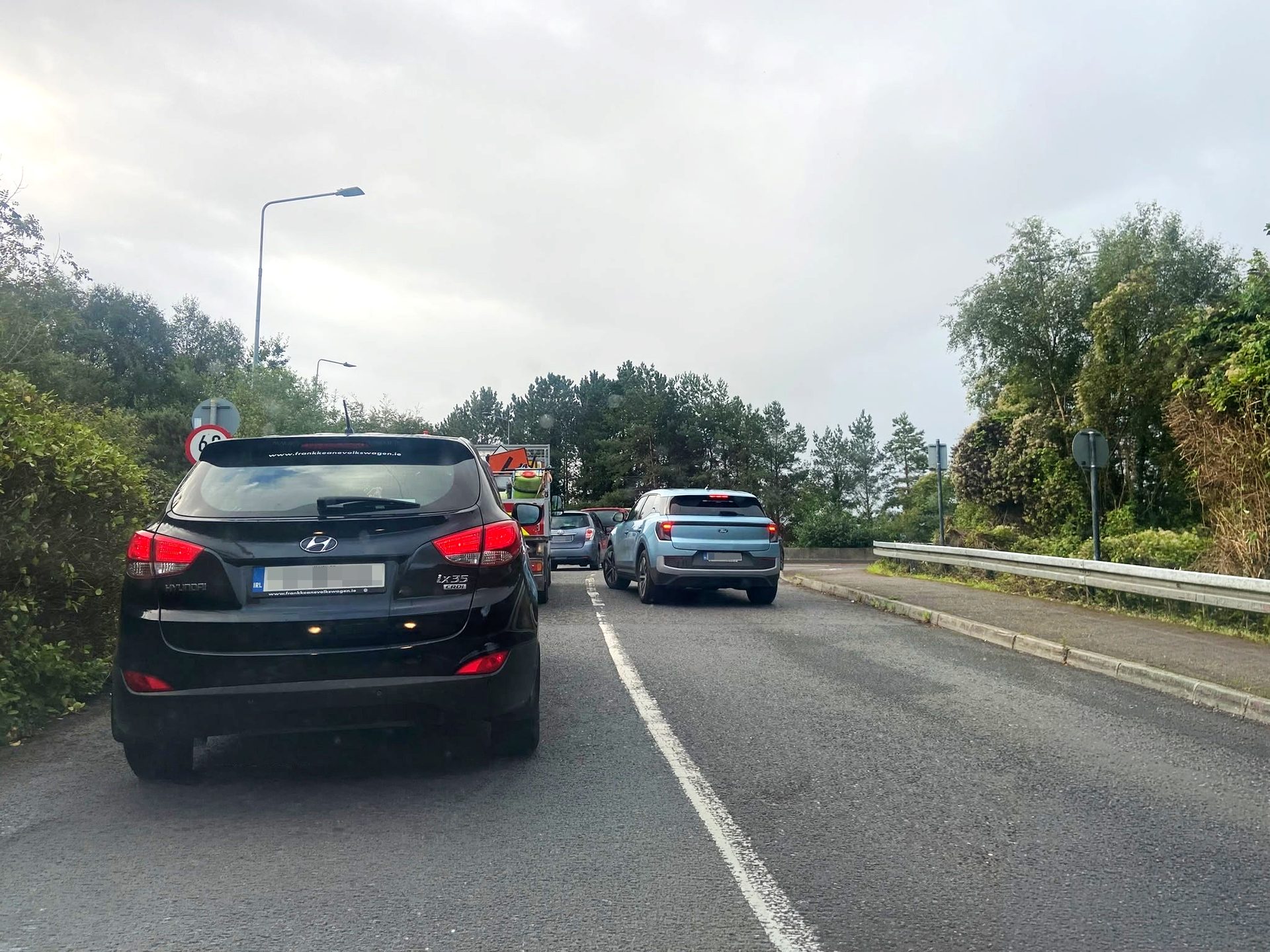
Mounting traffic gridlock at the Coolcorcoran junction onto the N22 Killarney Bypass is causing daily delays for commuters, with local motorists calling on Killarney Municipal District and elected representatives to take immediate action.
Early morning traffic coming from the Tralee side has become severely backed up past BG Motors during the peak 8.15am commute.
Motorists attempting to enter the bypass from the Coolcorcoran side face long queues and increasing frustration as they struggle to join the main road.
Local drivers point to a specific design issue at the exit, where a raised kerb and a section of unused footpath prevent left-turning vehicles from merging smoothly into the traffic flow.
Road users are requesting a simple layout modification to resolve the bottleneck: converting the exit to left-turn only, removing the kerb obstruction, and directing driver traffic to loop via a U-turn at the Killarney Sports and Leisure Centre roundabout. Similar left-turn measures were previously implemented at the nearby Lewis Road junction to improve safety and traffic flow.
The request comes as broader plans for the N22 bypass upgrade and new link road infrastructure remain under progression by Kerry County Council and Transport Infrastructure Ireland.
Motorists wishing to share their views on local road issues can email info@killarneyadvertiser.ie.


WEEK 14: Felicity’s Summer in Killarney
WEEK 14Felicity’s Summer in Killarney Previously: Here on Dundag it was far easier to relax than anywhere else. They had...

Frustration mounts over morning gridlock at Coolcorcoran
Frustration mounts over morning gridlock at Coolcorcoran Mounting traffic gridlock at the Coolcorcoran junction onto the N22 Killarney Bypass is...


Ailbhe Keogan scoops top television writing award
Acclaimed Kerry screenwriter Ailbhe Keogan has won the Best TV Drama Script award at the 19th Writers’ Guild of Ireland...


Strong turnout for St Paul’s Golf Classic at Beaufort
After a recent spell of indifferent weather, glorious sunshine and a gentle breeze greeted 35 teams at Beaufort Golf Course...


€150,000 granted to draft masterplan for St Finan’s site
Kerry County Council has been awarded €150,000 in government funding to progress a Masterplan and Infrastructure Delivery Plan for the...


Fossa Swimmers make a splash at County Finals
The Fossa Swim team pictured at the Tralee Sports Complex following their successful outing at the County Finals of the...


On the Ball Part 2 of the Mikey Daly Interview
Éamonn Fitzgerald EF: Killarney Celtic are invited to participate in an Irish competition. That has big financial implications for travel,...


LUKE MANGAN recently caught up with Kerry FC’s manager, Colin Healy.
He spoke to him about his careers as a player and manager. Here’s how it went: When you began your...


Home cup tie for St Paul’s could be epic
Paudie O’Connor National Cup (Round 1) Utility Trust St Paul’s v GCU Brunell Saturday 7.30pm Killarney Sports and Leisure Centre...


Chances of Kerry v Cork Munster final in 2026 decrease as Munster GAA delay seeding plan
After facing a backlash from Limerick, Clare, Waterford and Tipperary players, Munster GAA have postponed their plan to keep Cork...
