
News
Some Killarney residents should watch their gardens like hawks

&
A “compelling” case is being made for the intensive use of lands within walking distance of Killarney town for housing. Close to 700 residential units will be needed, according to the draft Killarney Municipal District Plan for the next six years.
For Killarney town, so compelling is the case in the well-put-together, suspiciously cohesive, logically built-up and well-written plan, one wonders if one smells a CPO - a Compulsory Purchase Order?
For instance, we are told up front that the zoning strategy is to “build up critical mass” in the towns and villages of the Killarney area.
We are told that Killarney is the only town to have enjoyed significant growth, going from 13,760 in 2011 to 15,312 in 2016. Although the growth can’t be properly measured because of changes in census boundaries, we are told in another section.
We are told that Killarney has “unique” requirements as a tourist town and that this places significant pressure on local accommodation, in terms of provision and cost.
“In addition to the absence of affordable accommodation, the town requires significant numbers of seasonal workers, which creates extra pressure in terms of the high numbers seeking local accommodation and high rental costs,” it is stated.
The figure of 685 units is mentioned in the context of Killarney’s unique status of being the town with the oldest average age in the nation, thanks, we are told, to all the retirees who move here.
Significant areas of available and serviced land are not being released onto the market, and the proposal now is for almost 70 hectares south of the bypass and north of the Flesk to be zoned for housing. Next to nothing is to be allowed beyond this until houses have gone up in that area.
But the real meat, I suspect, is in the statement that as much as 30 per cent of the new housing will beon “infill or brownfield sites” within the town.
(By the way, there is a lovely howler on page 52, under the section “Housing Land Requirement”, where it states that “a principal tenant” of the approach is a sequential approach to zoning of residential lands, extending outwards from the centre. Nice one!)
But the part that interests me most is this:
“The Local Authority shall facilitate the redevelopment of all backland, infill, vacant and derelict sites throughout the town. It will encourage the construction of well-designed, high-density apartments or residential units subject to achieving a high quality of living accommodation for incoming residents, adequate provision of amenity space and refuse storage.”
Then there is the rather cheeky step of corralling the back gardens of the old houses in New Street, with accompanying map. And statements that New Street is to be” regenerated”.
In this context too, the Mission Road and Beech Road car park will be developed for housing and commercial, it is envisaged.
Green Lane and Pound Lane are other areas where there is plenty of “underutilised rear residential gardens”. Sunnyhill, too, gets a mention in the unused land context.
The “sizeable” gardens in New Street would be developed as “a cohesive unit”, it is envisaged. This is, of course, language for a “new New Street” into the area south and adjoining Beech Road car park.
One thing interests me: with the plans for higher density within the town walls, as it were, what sort of heights are we really talking about? Heights like the Plaza? The Cathedral? The Beech Road apartments? The question of height provokes headaches in Killarney and there are real concerns about infill development. So any kind of gung-ho approach as appears in the new town plan about filling in here, there and everywhere on the basis of great need, warrants very careful scrutiny, it seems to me.
Already a situation is developing where Kerry County Council have opened an enforcement file on the two-storey mews building underway at the back of the West End, one of the town’s oldest buildings. New Street residents complained that windows are going in at the eastern side where they should not go in in the apartment development and will overlook their gardens and privacy and deprive them of light. A warning letter has been issued from the council to the applicants.
And let's face it, this town has not distinguished itself in the development allowed in many of the old lanes.
Back to the draft plan. In the middle of it all, the horseshoe bat gets prime mention in the plan. I can’t understand the horseshoe bat’s import… and have to digress a bit here again. The lesser horseshoe bat gets a whole page to himself. I blinked a bit here. Is this about the jarvey horses and my bad eyesight? No, the lesser horsehoe bat.
Actually, he is actually in good condition we are told. Great! However, he could be disturbed by artificial lighting. Okay! Right!
On a morning where deer - also protected - are hopping in front of motorists and taking up car parking spaces in Beech Road, I would have thought they deserved a mention in a draft plan for their impact on the town, if only to protect humans?
But away from the deer and the bats. If I were a resident of Green and Pound Lanes and Lower New Street, and maybe Sunnyhill, I would be watching my little back garden roost like the proverbial hawk.
Submissions can be made until June 15.


Paralympic legend Jason Smyth visits St Brendan’s
World renowned Paralympian and world record holder Jason Smyth paid a visit to St Brendan’s College on Wednesday afternoon as part of a high profile visit to Killarney.
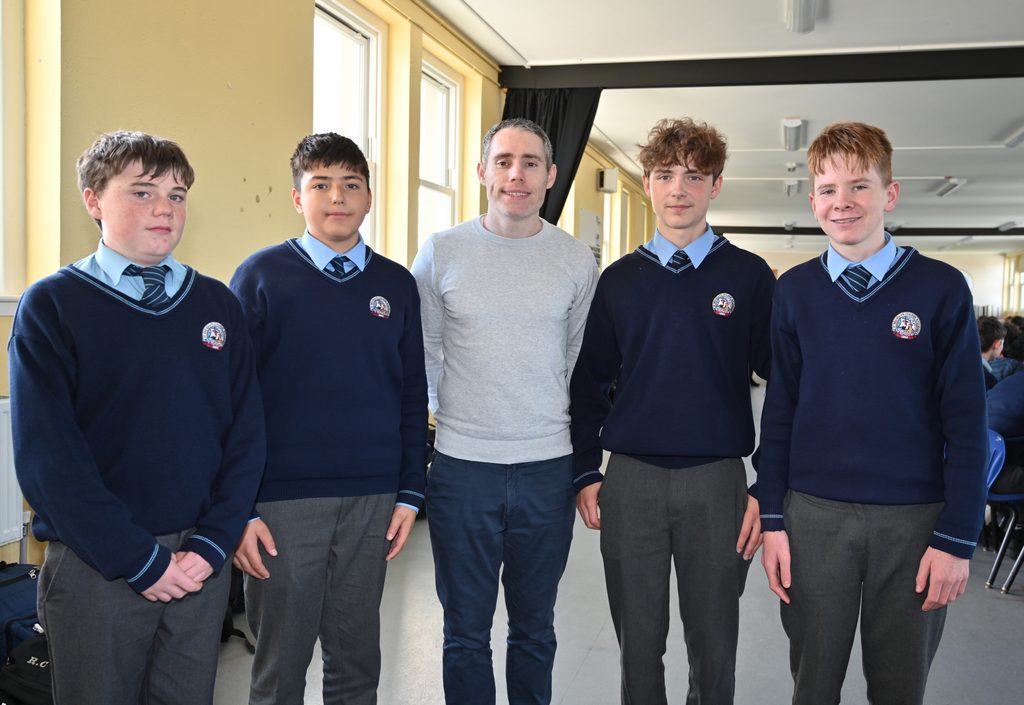
The six time Paralympic gold medallist spoke to second year students from St Brendan’s College, alongside students from neighbouring schools St Brigid’s Presentation Secondary School and Killarney Community College.
The interactive talk and interview took place ahead of World Sight Day, with the legendary sprinter sharing his personal journey with Stargardt disease, a genetic eye condition that left him legally blind at eight years old.
The Derry native, who holds the world record as the fastest Paralympian on earth over 100 metres, offered inspiring insights into overcoming physical adversity and achieving success at the highest level of world sport.
The school visit formed the opening leg of his Killarney schedule before he took centre stage later on Wednesday evening at The Killarney Plaza Hotel & Spa.
Smyth headlined An Evening with Paralympian Jason Smyth, an event organised by the Killarney Chamber of Tourism and Commerce as part of its winter schedule, sponsored by AIB.


Paralympic legend Jason Smyth visits St Brendan’s
Paralympic legend Jason Smyth visits St Brendan’s World renowned Paralympian and world record holder Jason Smyth paid a visit to...

Deerpark Retail Park placed on market for fifteen million euro
Deerpark Retail Park in Killarney has officially been placed on the market with a guide price in excess of 15.4...


Killarney Racecourse to host first professional festive pantomime
Killarney Racecourse to host first professional festive pantomime A classic fairytale is set to receive a distinct Kerry makeover this festive...


Kerry artist explores identity at ANAM
Kerry artist explores identity at ANAM Kerry artist Felix Power is inviting the Killarney community to explore personal ideas of...


Town encouraged to wear bright colours for Kevin
Town encouraged to wear bright colours for Kevin The town of Killarney was encouraged to wear its brightest colours this...


Fossa Swimmers make a splash at County Finals
The Fossa Swim team pictured at the Tralee Sports Complex following their successful outing at the County Finals of the...

On the Ball Part 2 of the Mikey Daly Interview
Éamonn Fitzgerald EF: Killarney Celtic are invited to participate in an Irish competition. That has big financial implications for travel,...


LUKE MANGAN recently caught up with Kerry FC’s manager, Colin Healy.
He spoke to him about his careers as a player and manager. Here’s how it went: When you began your...


Home cup tie for St Paul’s could be epic
Paudie O’Connor National Cup (Round 1) Utility Trust St Paul’s v GCU Brunell Saturday 7.30pm Killarney Sports and Leisure Centre...


Chances of Kerry v Cork Munster final in 2026 decrease as Munster GAA delay seeding plan
After facing a backlash from Limerick, Clare, Waterford and Tipperary players, Munster GAA have postponed their plan to keep Cork...
