
News
Why have some flowers been forgotten?


By Debby Looney, gardening expert
It seems that every day new plants are created with a variety of colours and shapes of leaves/flowers… all with patents and rights attached so growers/inventors can make money, and consumers continue to buy.

.

.
And designers also have the opportunity to make beautiful new labels to entice us. So many of these have short life spans, and cannot withstand our weather. They are hyped up, the market is flooded, the trend is set, and the customer buys. We are all victim to it, myself included.
However, what of the old plants, the reliable ones our grandparents grew? In the vegetable world they would be known as heirloom varieties. In the fashion industry it is called vintage. In the gardening world they are called boring! In recent years, as I see one thing after another failing, I am beginning to appreciate the boring plants!
Take Potentillas for example, they come in red, orange, cream, yellow, flower all summer from April onwards, need no pruning or dead-heading, and are generally disease free and hardy. Why have they been forgotten? ‘Yellow Queen’, ‘Primrose Beauty’, ‘Abbotswood white’ and ‘Red Ace’ are excellent varieties.
Spirea is another plant which is not as popular as it should be. ‘Snowmound’ has delicate bright green leaves on arching branches. In early spring it is covered in pure white flowers. ‘Goldmound’ has bright red new foliage which turns a lovely shade of gold, and flowers pink throughout the summer. ‘Golden Princess’ and ‘Little Princess’ are dwarf varieties.
Astilbe, also commonly called Spirea, is a perennial with spikes of red, pink, cream or white flowers. They are great fillers, and will grow in any soil. Slug and rabbit resistant - a must have. Shasta daisies are also reliable, however, go for the original single flowered one. All the funky, spiky, double types need care and attention and well-drained soil!
Cistus, or rockrose, is another old-fashioned plant which has fallen out of favour. I am not sure why, as it is compact, free-flowering, evergreen and easy to grow! There are many varieties to choose from, but mainly pink and white. It is advisable to cut it back by half after flowering, to prevent it going woody and too big.
It is not just in the world of shrubs and perennials that old favourites are pushed aside. Are you growing Alyssum? The white and blue borders, as they are known, are forgotten about! Also marigolds, and especially Tagetes, are not that popular but they keep midges away, and their scent is delicious. Pretty yellow flowers, they withstand wind, rain and heat. Ageratum always reminds me of my grandmother, and as such I always have it - but it is so hard to get it is almost rare! Salvia is another bedding plant which has been left by the wayside, but show me another red as vibrant!
So, even though new plants are exciting, it is worthwhile building a garden around tried and tested reliables. It is after 15 years of spending money, digging out and transplanting, disappointment and questioning myself as a gardener, that I come to you with this advice!

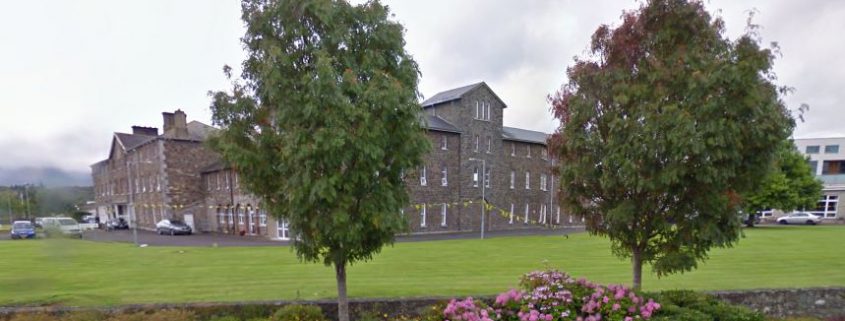
A design team has been appointed to advance plans for the proposed Minor Injury Unit on the grounds of St Columbanus Home though the HSE has confirmed it cannot yet give a construction or opening timeline.
Fianna Fáil TD Deputy Michael Cahill received the update in response to a Parliamentary Question submitted to the Minister for Health. HSE South West confirmed the newly appointed team will progress the project through design development, planning, and regulatory approval following the transfer of residents to the new Killarney Community Nursing Unit.
Deputy Cahill welcomed the appointment of the design team but raised concerns over the lack of a definitive schedule.
“I welcome the appointment of a design team, which represents progress towards delivering this important facility. However, I am concerned that the HSE is still unable to provide a definitive timeline. Previous indications from HSE officials pointed towards construction commencing in 2026, with completion anticipated in 2027. We now need clarity on the project schedule and assurances that there will be no unnecessary delays,” Deputy Cahill said.
He noted that the facility is vital to serve Killarney and the wider east, mid, and south Kerry regions while relieving pressure on the Emergency Department at University Hospital Kerry.
The HSE also confirmed it is finalising a broader review of healthcare accommodation across Killarney to develop the St Columbanus campus as an integrated healthcare hub.
“As a member of the Oireachtas Joint Committee on Health, I will continue to press the HSE and the Minister for Health to ensure this project is progressed without further delay. People across Killarney, east, mid, west and south Kerry deserve certainty. The appointment of a design team is welcome but the next priority must be getting this project to construction and delivering the facility,” Deputy Cahill concluded.
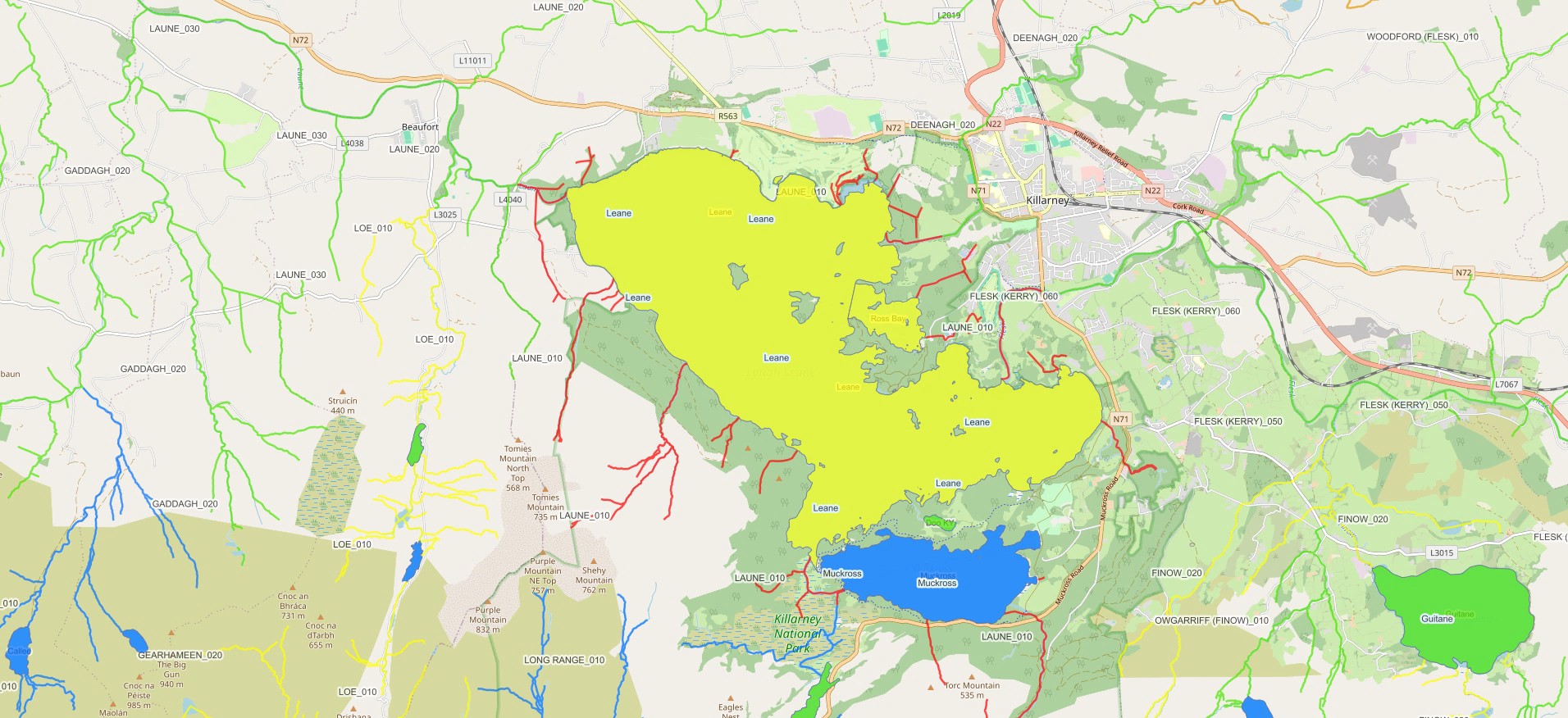
Lochanna Beo’s mapping highlights water quality concerns
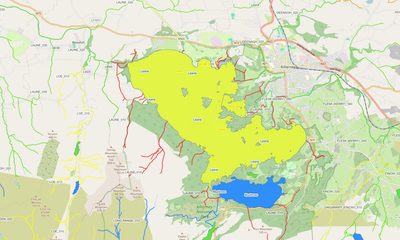
Local environmental action group Lochanna Beo has released mapping data from the Environmental Protection Agency (EPA) to draw attention to deteriorating water quality across Killarney and the broader Laune Catchment.
The EPA map uses a colour-coded system to rate water quality status from 2019 to 2024: blue indicates high status, green indicates good, yellow represents moderate, brown denotes poor, and red signifies bad status.
The figures indicate significant ecological pressure on local lakes and rivers compared to neighbouring areas across County Kerry.
Formed during the summer of 2026, Lochanna Beo aims to bring together residents, business owners, agricultural operators, and public bodies to address the key factors affecting the regional aquatic ecosystem.
The community initiative is seeking direct engagement with relevant statutory authorities to implement practical restoration measures and protect the long-term health of Killarney’s water bodies.

Design team appointed for injury unit
A design team has been appointed to advance plans for the proposed Minor Injury Unit on the grounds of St...

Lochanna Beo’s mapping highlights water quality concerns
Lochanna Beo’s mapping highlights water quality concerns Local environmental action group Lochanna Beo has released mapping data from the Environmental...


Stefan Caulfield-Dreier signs professional cycling contract
Former Killarney Cycling Club rider Stefan Caulfield-Dreier has secured a professional contract with leading Dutch-based outfit Azerion-Villa Valkenburg. The 23-year-old...


Church seeks creative Christmas trees for festival
Church seeks creative Christmas trees for festival The Methodist Church in Killarney is inviting local schools, community groups, businesses, and...


€6,000 Scrooge Giveaway!
€6,000 Scrooge Giveaway! Six lucky audience members will each walk away with €1,000 as the Gleneagle Arena welcomes an extraordinary...


Fossa Swimmers make a splash at County Finals
The Fossa Swim team pictured at the Tralee Sports Complex following their successful outing at the County Finals of the...


On the Ball Part 2 of the Mikey Daly Interview
Éamonn Fitzgerald EF: Killarney Celtic are invited to participate in an Irish competition. That has big financial implications for travel,...


LUKE MANGAN recently caught up with Kerry FC’s manager, Colin Healy.
He spoke to him about his careers as a player and manager. Here’s how it went: When you began your...


Home cup tie for St Paul’s could be epic
Paudie O’Connor National Cup (Round 1) Utility Trust St Paul’s v GCU Brunell Saturday 7.30pm Killarney Sports and Leisure Centre...


Chances of Kerry v Cork Munster final in 2026 decrease as Munster GAA delay seeding plan
After facing a backlash from Limerick, Clare, Waterford and Tipperary players, Munster GAA have postponed their plan to keep Cork...
