
News
Slow Travel with Diarmaid Griffin


Tóg go bog é

Diarmaid Griffin

Diarmaid Griffin
The premise of slow travel is one that is gaining popularity across the world and it can be summarised by that old Irish phrase ‘tóg go bog é’ which translates to ‘take it easy’ or ‘take it softly’.
‘Bog’ is also a place and a Scots Gaelic/Irish Gaelic word that started to be used in the English language circa 1500. It means soft; which for those that have spent any time in the bog, makes perfect sense!
The majority of boglands in the Killarney area are Atlantic blanket bogs as like a blanket, they stretch over vast areas but are not particularly deep (2-7metres). These Atlantic boglands were formed in part by the regular, high rainfall that we get here on the west coast of Ireland. Mountain blanket bogs are found in our uplands (+200 metres above sea level) and are very similar in formation.
Boglands started to form here around 7,000 years ago and most formed around 4,000 years ago when our climate became wetter. This heavy rain, which we are all too familiar with, leached minerals from the soil over time. Amongst these minerals was iron, that washed down through the soil to form an iron pan. This pan became impermeable, so no water could escape from the surface. Waterlogging resulted and this prevented decomposition. Layers of organic material builds up, year on year, slowly accumulating over hundreds and thousands of years. This is partial decomposed vegetation that is now a carbon store and can give us an insight into the plants that grew here, thousands of years ago. Only a small amount of blanket bog exists in the world, with Ireland being the most important country in Europe for this habitat.
Boglands or peatlands are not only wet and soft but are low in nutrients, which poses a challenge to the plants that make this habitat their home. This environment has led to dramatic adaptations that are demonstrated by bog myrtle, sundew, and butterwort. Sundew and butterwort are two native plants of our boglands that survive by attracting and capturing insects. Consuming these protein rich insects provides these deadly plants with the nitrogen they need to live healthy and happy lives!
Bog myrtle, or sweet gale as it is otherwise known as, has a different strategy, one of cooperation and collaboration. It has nodules in its root system, that accommodate special bacteria that can take nitrogen from the air and ‘fix it’ to become nitrogen useful to the plant. The bacteria get a home and food, while the bog myrtle gets the nitrates that it so badly needs.
The most prolific grass of the uplands is called purple moor grass and it is this that causes the marked change of colour on our mountains and hills, from the green of summer to the brown of winter. Despite it being so successful, it too has its limits and decides to shut up shop for the winter. It dies back in winter, retreats into the ground and casts off its leaves just like our deciduous trees.
No article on boglands would be complete without mentioning sphagnum. This species of moss, like all mosses is a primitive plant, without a root system that relies on heavy rainfall in waterlogged habitats. It is so absorbent of liquid that it was used during World War 1 for absorbing blood. This important plant also has an antibacterial quality that make it a valuable resource for wounds. It is very important in the absorption of rain after heavy rainfall events, by acting like a sponge, thus preventing flooding further downstream. In fact, dried sphagnum can absorb 20 times its weight in liquid.
As spring slowly unfurls, why not take a walk in a bogland near you. If you don’t feel like an uphill trek, there are other options. The well signed Bog Walk that was established by Kilcummin Rural Development is open to the public and more details can be found on their Facebook page. Boglands are truly great places to ‘tóg go bog é’.
For more insights, or to join me on one of my tours, follow me on Instagram @slowtravelkerry or email me diarmaid@slowtravelkerry.ie.




Tourism Ireland CEO Outlines Global Strategy at KTIF Tourism Day
The CEO of Tourism Ireland, Alice Mansergh, was in Killarney on Tuesday of this week to address tourism leaders from...


Kerry Stars honours the Late Vincent Lacke with Memorial Tournament
The second annual Vincent Lacke Memorial Soccer Tournament took place on Sunday at the Killarney Sports and Leisure Centre. Organised...

Registration opens for 44th Ring of Kerry Charity Cycle
Registration is now open for the 44th annual Ring of Kerry Charity Cycle, with thousands of cyclists expected to descend...

Parade will be one of the best in the country
This year’s St Patrick’s Day parade in Killarney – which promises to be one of the most colourful and imaginative...

Pedestrian crossing update at Killarney Athletic
Killarney Athletic AFC is a step closer to securing a new pedestrian crossing following an update at Wednesday’s Killarney Municipal...
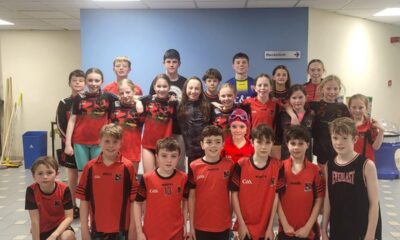

Fossa Swimmers make a splash at County Finals
The Fossa Swim team pictured at the Tralee Sports Complex following their successful outing at the County Finals of the...

On the Ball Part 2 of the Mikey Daly Interview
Éamonn Fitzgerald EF: Killarney Celtic are invited to participate in an Irish competition. That has big financial implications for travel,...


LUKE MANGAN recently caught up with Kerry FC’s manager, Colin Healy.
He spoke to him about his careers as a player and manager. Here’s how it went: When you began your...


Home cup tie for St Paul’s could be epic
Paudie O’Connor National Cup (Round 1) Utility Trust St Paul’s v GCU Brunell Saturday 7.30pm Killarney Sports and Leisure Centre...


Chances of Kerry v Cork Munster final in 2026 decrease as Munster GAA delay seeding plan
After facing a backlash from Limerick, Clare, Waterford and Tipperary players, Munster GAA have postponed their plan to keep Cork...
