News
An Garda Síochána reintroduces ‘Operation Fanacht’ nationwide to support public health guidelines

Following the Government’s decision to move the country to Level 3 of the National Framework for Living with COVID-19, An Garda Síochána will re-commence ‘Operation Fanacht’, from midnight tonight (Tuesday), as a nationwide policing operation focused on supporting public compliance with public health measures.
Under Level 3, people are being encouraged not to travel out of their county unless for essential reasons. In support of this announcement there will be high visibility patrolling by Garda members across the country with the focus of this activity continuing to be encouraging people to adhere to national public health measures.
It will involve 132 large-scale checkpoints a day on main arterial routes around the country in addition to thousands of mobile checkpoints on secondary routes in towns and villages a week.
"An Garda Síochána’s priority is keeping people safe,” Commissioner Drew Harris said. “This will be a major policing operation across the country with high visibility of Garda members to support public health measures. An Garda Síochána is encouraging people not to travel out of their county unless it is for essential purposes. We want to advise people that we will be conducting major checkpoints on main routes and travelling by road from tomorrow will be different from travelling today. People using the roads are likely to face delays.”
Since the start of the pandemic, An Garda Síochána has adopted a graduated policing approach based on its tradition of consent, he added.
“We have seen compliance by the vast majority of the public with this approach. Independent surveys have also found significant public support for it. We will continue to police in this way. We have also had a strong focus on the protecting and supporting the vulnerable. That will continue as well. If you need our help, please contact your local Garda station.”
As an organisation rooted in the community, An Garda Síochána understands the difficulties these measures place on everybody.
“More than ever, we all need to work together and adhere to public health guidelines and regulations to reduce the spread of COVID-19 and save lives.”
Community Response
An Garda Síochána remains committed to supporting the most vulnerable in society, particularly the elderly and those at risk. They have always worked closely with communities and will continue to do so in these extraordinary times.
"An Garda Síochána will continue to play our part to assist and support people, particularly those who are vulnerable and feeling isolated,” Deputy Commissioner John Twomey Policing and Security said.
“Your local Gardaí are here to help whether that is delivering medical prescriptions, collecting your pension or other supports you may need. Any person with these concerns for themselves or for a neighbour please contact your local Garda station.”
Operation Faoiseamh
Deputy Commissioner Twomey added, "Victims of domestic abuse remain a priority for An Garda Síochána. Our dedicated operation – ‘Operation Faoiseamh’ continues. This has seen thousands of contacts made with victims of domestic abuse, as well as arrests and over one hundred prosecutions commenced. During this phase of our response to COVID-19 the Garda National Protective Service Bureau and Divisional Protective Service Units will remain fully resourced. There are now Divisional Protective Service Units in every Garda Division.
"If you are a victim of domestic abuse or you know of a family member or friend who is a victim and may not be in a position to help themselves, I ask that you make contact with An Garda Síochána. If you require urgent assistance or support, please call 999 or 112. We are here to listen, to help and to protect.”
Operation Navigation
‘Operation Navigation’, which focuses on compliance with public health regulations by licensed premises, will continue nationwide and An Garda Síochána will enforce penal regulations using their graduated response. Where Gardaí find potential breaches of the public health regulations a file is prepared for the DPP in each case.
At this time, there has been no change to the role of specialist units (Special Tactics & Operations Command (STOC), Special Crime Operations, Detective/Drugs Units and Divisional Protective Service Units DPSUs) nationwide. These units will continue to support the community and Garda colleagues with a range of specialist services, and An Garda Síochána will continue to investigate and detect crimes which have continued throughout the pandemic to date.
From the start of the response to the COVID-19 pandemic An Garda Síochána has and will continue to adopt, a graduated policing response based on its tradition of policing by consent. An Garda Síochána’s response has been fair and proportionate.
In respect of regulations, including travel restrictions, which are not declared to be Penal Regulations under the Health Act 1947 as amended, An Garda Síochána will utilise the following three Es from the 4E approach - engage, explain and encourage, only.
In respect of regulations which are declared to be Penal Regulations under the Health Act 1947 as amended, An Garda Síochána adopts the approach of the Four Es which sees Gardaí engage, educate, encourage, and as a last resort, enforce. Where Gardaí find potential breaches of the public health regulations a file is prepared for the DPP in each case.
While An Garda Síochána will seek to encourage people to maintain the necessary public health measures, it will intervene where there is non-compliance with public health regulations.
An Garda Síochána wants to take this opportunity to remind everyone of the basic ways to protect yourself:
• Wash your hands frequently with soap and water or use an alcohol-based hand rub if your hands are not visibly dirty
• Practice good respiratory hygiene, that is, when coughing and sneezing, cover your mouth and nose with flexed elbow or tissue
• Maintain physical distancing, that is, leave at least two metres (six feet) distance between yourself and other people, particularly those who are coughing, sneezing and have a fever
• Avoid touching your eyes, nose and mouth – if you touch your eyes, nose or mouth with your contaminated hands, you can transfer the virus from the surface to yourself
• Reduce your social interactions

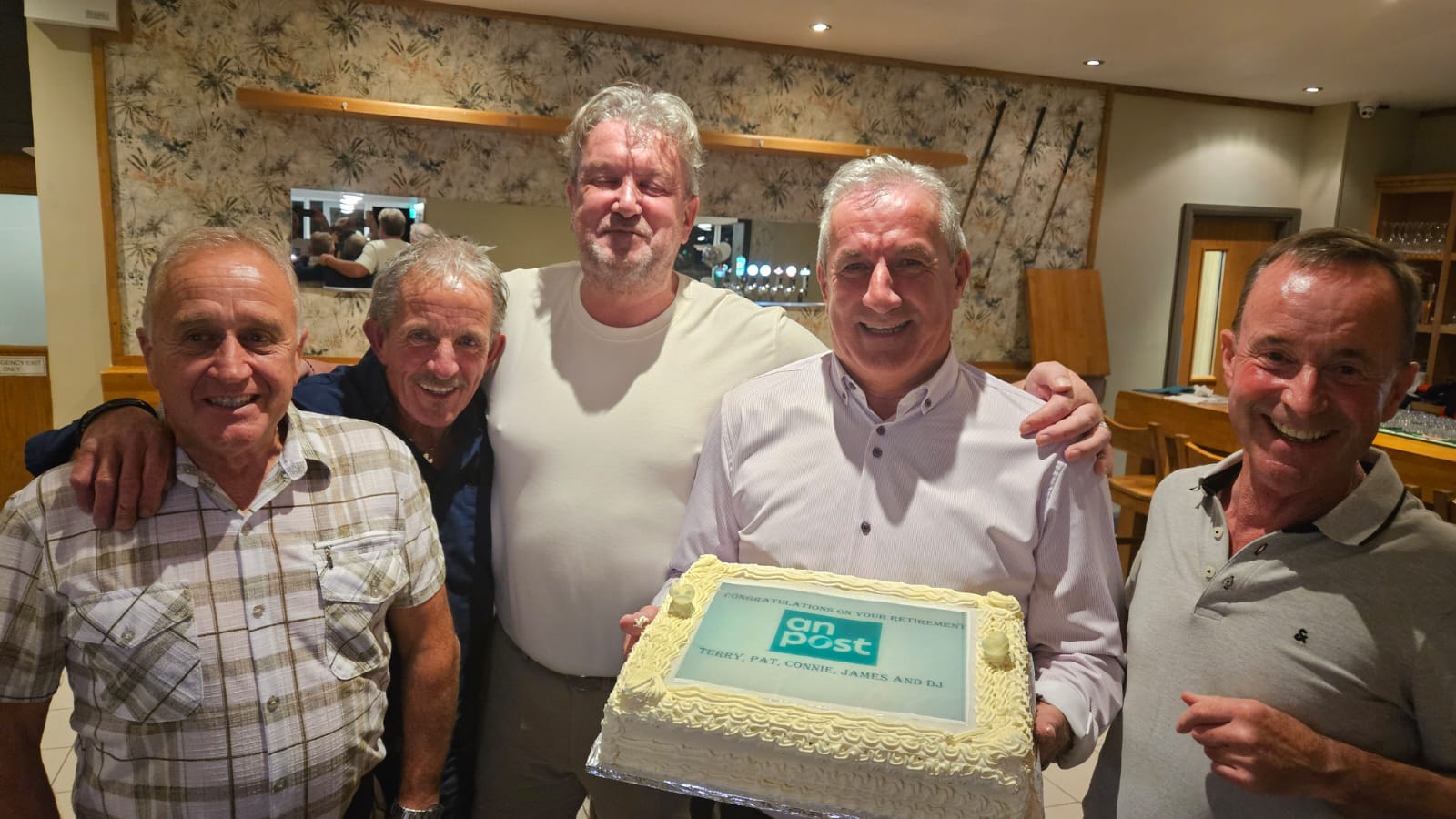
Five local postmen retire with 185 years service
RETIREMENT NIGHT: Pictured at the retirement party held at Killarney Racecourse on Saturday, October 3, celebrating a combined 185 years of service with An Post, are Connie Brady, James Foley, Terry Potts, Pat Cronin, and D.J. Cahill.
Five well-known local postmen celebrated their retirement at a special function held at Killarney Racecourse on Saturday night, October 3.
The event brought together current and former An Post colleagues to mark the combined total of 185 years of service delivered across Killarney and surrounding areas.
Delivery Services Manager Terry Potts retired after 43 years with An Post. He began his career in Dublin, where he worked for 10 years, before moving to Killarney in 1993 for a further 33 years.
Pat Cronin completed an impressive 51 years of service between Killarney and Farranfore, spending 44 of those years delivering post on the Farranfore route.
James Foley served 35 years with An Post, delivering on routes across Killorglin throughout his entire career.
D.J. Cahill marked 32 years of service based out of Killarney post office, delivering mail across Killarney town, Killorglin, Kilcummin, and Headford.
Connie Brady retired following 24 years with the postal service, spending 17 years in Killarney town before completing his service in Killorglin.
The celebration offered local postal staff an opportunity to gather and catch up ahead of the busy Christmas rush.


Five local postmen retire with 185 years service
Five local postmen retire with 185 years service RETIREMENT NIGHT: Pictured at the retirement party held at Killarney Racecourse on...


New Streetscapes murals launched at College Square
A colourful collaboration between the Kerry Local Creative Youth Partnership (LCYP) and the Architecture Kerry Festival at Kerry County Council...
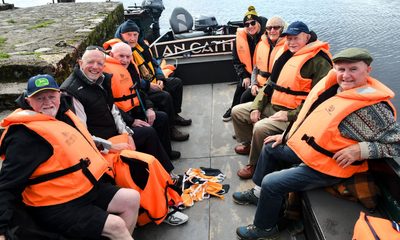

Dr Crokes stalwarts enjoy lake cruise
Dr Crokes stalwarts enjoy lake cruise Dr Crokes GAA Club hosted a special day out for its senior members on...


Green light for Torc to Dinis walkway
Green light for Torc Dinis walkway Planning approval has been granted for a long-awaited lakeside walkway and cycleway connecting Torc...
LOCAL GOLD:
LOCAL GOLD: Terrie O’Shea, founder and owner of Killarney-based business Sorella Berries, celebrating her Gold award win at the Blas...


Fossa Swimmers make a splash at County Finals
The Fossa Swim team pictured at the Tralee Sports Complex following their successful outing at the County Finals of the...


On the Ball Part 2 of the Mikey Daly Interview
Éamonn Fitzgerald EF: Killarney Celtic are invited to participate in an Irish competition. That has big financial implications for travel,...


LUKE MANGAN recently caught up with Kerry FC’s manager, Colin Healy.
He spoke to him about his careers as a player and manager. Here’s how it went: When you began your...


Home cup tie for St Paul’s could be epic
Paudie O’Connor National Cup (Round 1) Utility Trust St Paul’s v GCU Brunell Saturday 7.30pm Killarney Sports and Leisure Centre...


Chances of Kerry v Cork Munster final in 2026 decrease as Munster GAA delay seeding plan
After facing a backlash from Limerick, Clare, Waterford and Tipperary players, Munster GAA have postponed their plan to keep Cork...