
News
Businesses in pre-budget talks with Minister Chambers

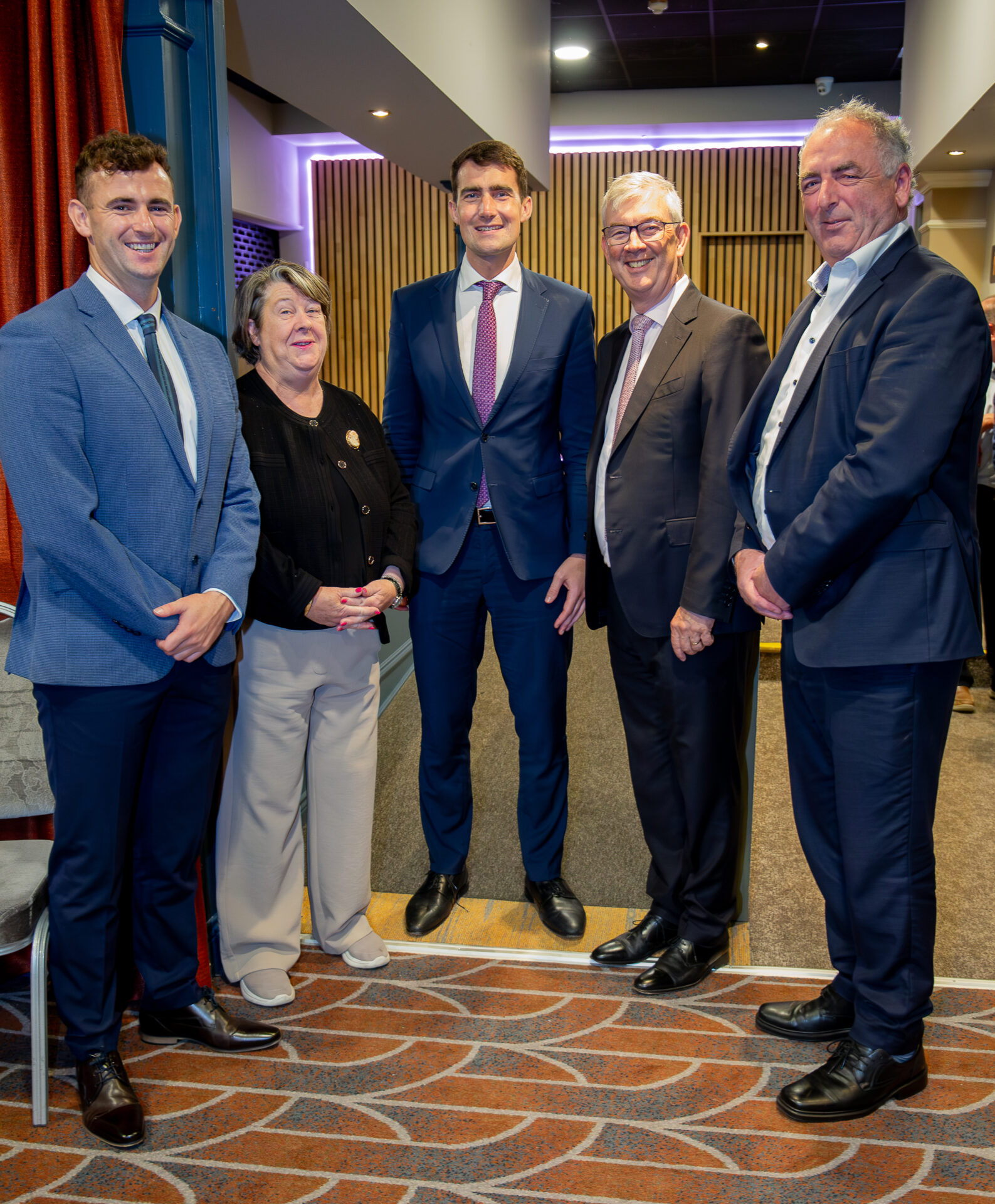
Minister for Public Expenditure Jack Chambers held a discussion at Gleneagle for business owners to voice their concerns ahead of next month’s budget.
The event, organised by Kerry Fianna Fáil TD Michael Cahill, took place on Wednesday.
It aimed to give business owners an opportunity to discuss items that might affect their business in the upcoming budget.
In his opening address to the attendees, Minister Chambers explained that the Government aims to shape the budgetary process by actively responding to feedback and addressing concerns to future-proof the economy.
Minister Chambers advised that his current focus right now is reducing the red tape and the bureaucracy that has built up over recent years.
He pointed out that road projects now take 15 years ago to complete, compared to just seven years in the early 2000s.
He said shortening these timelines will give life to funded projects which in turn will boost confidence within the business community.
He said that while Ireland is a point of strength in comparison to our “stagnant” European counterparts, we need to approach the upcoming budget with a “crisis mindset” as things are subject to change.
Different issues were brought up by attendees at the event, including housing, planning, insurance and business costs.
Concerns were addressed by Minister Chambers, Deputy Michael Cahill and Councillor Tommy Cahill.
PLANNING
One attendee raised concern about planning regulations, particularly in rural areas.
He noted that in his locality, his house was the last to be built over twenty years ago.
He said younger people are forced to move elsewhere due to the strict planning rules.
Minister Chambers acknowledged the current planning regulations are overly strict and highlighted it as an issue that needs to be addressed by Government.
He said that Minister for Housing James Browne is open to examining it further.
He explained that 32,000 homes were built last year, 50% of which were state supported. He warned that if Government were to build 50,000 houses, it would be unsustainable to maintain the same level of State involvement.
Minister Chambers said that planning restrictions, particularly in rural areas, should be reviewed and eased where possible for those willing to do it themselves.
HOUSING
Another issue raised by an attendee was the unaffordability of housing in Killarney.
She said there are two categories: those who have a million euro to spend or those on the social housing list; there is nothing available for those in the middle.
She explained that young families are being priced out of the town and that areas such as Barraduff, which is a 10-minute drive away, are now considered part of Killarney.
She noted that people in their 30s are still living at home as they simply cannot afford to move out.
In response, Minister Chambers said the most effective solution is to zone more land to meet market demand.
WATER:
Fianna Fail Councillor Tommy Cahill raised the issue of wastewater infrastructure and the length of time it takes to complete.
He specifically spoke about the Beaufort wastewater plant that was allocated €6 million. He was advised in a parliamentary question that it would take seven more years before it goes through planning and construction.
Minister Chambers acknowledged that these long waiting times are “out of sync” with the economy.
INSURANCE:
One business owner reported that he is paying €100,000 in insurance, and if he has a higher revenue than expected in any given year, his premium rises requiring him to pay additional amounts beyond the agreed rate.
He expressed frustration, saying he feels penalised for having a successful year in business.
After the event concluded, Minister Chambers said there is “great positivity” among the business community In Killarney.
Minister Chambers explained while the economy is still in a good place, every budget must account for growth, to continue prosperity and to invest in infrastructure.
He said the most common piece of feedback he noted in Killarney was water infrastructure, which he says has been prioritised by the Government in the new National Development Plan.

Frustration mounts over morning gridlock at Coolcorcoran
Mounting traffic gridlock at the Coolcorcoran junction onto the N22 Killarney Bypass is causing daily delays for commuters, with local motorists calling on Killarney Municipal District and elected representatives to take immediate action.
Early morning traffic coming from the Tralee side has become severely backed up past BG Motors during the peak 8.15am commute.
Motorists attempting to enter the bypass from the Coolcorcoran side face long queues and increasing frustration as they struggle to join the main road.
Local drivers point to a specific design issue at the exit, where a raised kerb and a section of unused footpath prevent left-turning vehicles from merging smoothly into the traffic flow.
Road users are requesting a simple layout modification to resolve the bottleneck: converting the exit to left-turn only, removing the kerb obstruction, and directing driver traffic to loop via a U-turn at the Killarney Sports and Leisure Centre roundabout. Similar left-turn measures were previously implemented at the nearby Lewis Road junction to improve safety and traffic flow.
The request comes as broader plans for the N22 bypass upgrade and new link road infrastructure remain under progression by Kerry County Council and Transport Infrastructure Ireland.
Motorists wishing to share their views on local road issues can email info@killarneyadvertiser.ie.




Frustration mounts over morning gridlock at Coolcorcoran
Frustration mounts over morning gridlock at Coolcorcoran Mounting traffic gridlock at the Coolcorcoran junction onto the N22 Killarney Bypass is...


Ailbhe Keogan scoops top television writing award
Acclaimed Kerry screenwriter Ailbhe Keogan has won the Best TV Drama Script award at the 19th Writers’ Guild of Ireland...


Strong turnout for St Paul’s Golf Classic at Beaufort
After a recent spell of indifferent weather, glorious sunshine and a gentle breeze greeted 35 teams at Beaufort Golf Course...


€150,000 granted to draft masterplan for St Finan’s site
Kerry County Council has been awarded €150,000 in government funding to progress a Masterplan and Infrastructure Delivery Plan for the...

GoSafe cameras live at Farranfore level crossing next week
GoSafe cameras live at Farranfore level crossing next week Automated speed cameras at the Farranfore rail level crossing will become...


Fossa Swimmers make a splash at County Finals
The Fossa Swim team pictured at the Tralee Sports Complex following their successful outing at the County Finals of the...

On the Ball Part 2 of the Mikey Daly Interview
Éamonn Fitzgerald EF: Killarney Celtic are invited to participate in an Irish competition. That has big financial implications for travel,...


LUKE MANGAN recently caught up with Kerry FC’s manager, Colin Healy.
He spoke to him about his careers as a player and manager. Here’s how it went: When you began your...


Home cup tie for St Paul’s could be epic
Paudie O’Connor National Cup (Round 1) Utility Trust St Paul’s v GCU Brunell Saturday 7.30pm Killarney Sports and Leisure Centre...


Chances of Kerry v Cork Munster final in 2026 decrease as Munster GAA delay seeding plan
After facing a backlash from Limerick, Clare, Waterford and Tipperary players, Munster GAA have postponed their plan to keep Cork...
