Connect with us

Sport

Manner of victory over Tyrone proves that Kerry are a different animal now

Published

on

by Adam Moynihan

"There’s no one harder on Kerry than our own people." As assertions go, it wasn't quite 'Páidí in South Africa', but Jack O’Connor’s post-match comments regarding Kerry fans and their tendency to err on the negative side rang true.

Kerry had just demolished Tyrone in Croke Park. It was a commanding, double-scores win that underlined the reigning champions’ credentials as one of the frontrunners for the 2023 All-Ireland.

What Jack was alluding to was that few had predicted such an outcome, particularly at home in The Kingdom. While most pundits tentatively backed Kerry to get the job done, many of the fans I spoke to last week were worried that this would be their last day out of the summer.

The fact that it was Tyrone in the other corner did little to boost confidence levels. Memories of 2021 and that ambush in the rescheduled semi-final still haunted them.

There seems to be this perception in the rest of the country that Kerry fans always think their team is going to win, even when the odds are against them. I would actually say the converse is often true: a lot of Kerry fans think Kerry are going to lose, even when the odds are in their favour.

In the end, there was nothing to worry about. Kerry were brilliant and they dealt with Tyrone with relative ease. We will get one more day in Dublin out of them; Derry await in the All-Ireland semi-final on Sunday week.

MEANING

Oftentimes a blowout win can be facile and a bit pointless but this one was loaded with meaning.

Firstly, and most obviously, beating Tyrone in Croke Park and settling the score from two years ago is a relief. For many of the players, that extra-time defeat will have been a career low. It can be parked now. They can beat Tyrone. Next question.

Kerry also proved that they have made significant improvements in key areas. In 2021, they turned the ball over 30 times. They lacked composure and patience and they ran straight into Tyrone’s trap time and time again. When they lost the ball, their defence was weak. They lacked intensity and cohesiveness, and the three goals they conceded probably cost them the All-Ireland.

On Saturday, they showed how far they have come. When faced with Tyrone’s packed defence, they were smart about it. They minded the ball, they bided their time, they avoided contact, and they punched holes when the time was right. They gave up 14 turnovers, 16 fewer than they did in 2021. Chalk and cheese.

Defensively, Kerry were a different animal completely compared to the last championship meeting between the two teams. These days Tyrone are arguably more dangerous in attack with the emergence of the excellent Canavan brothers but, as we saw throughout 2022, Jack O’Connor and his coaches seem to have cracked the defensive code.

With everyone buying into the team’s solid defensive structure, with Tadhg Morley providing the cover, and with the exceptional Jason Foley and Tom O’Sullivan nullifying Darren McCurry and Darragh Canavan, Kerry limited Tyrone to just six points in each half. Crucially, they conceded no goals.

They hunted in packs, tracked runners, and generally displayed a level of aggression rarely seen in the years prior to O’Connor’s return. On more than one occasion, lads who are fairly relaxed and unassuming off the pitch – the likes of Gavin White, Diarmuid O’Connor and Tom O’Sullivan – fronted up to an opponent after a turnover or a Kerry score to let them know that this was Kerry’s day.

Everything about the team’s demeanour pointed towards a ferocious collective desire to stand tall and to not be bullied in the manner that Tyrone have sometimes bullied Kerry in the past.

Diarmuid O’Connor’s performance is deserving of special praise. Kerry’s midfield has come in for plenty of criticism this year (I have voiced concerns myself) but he arrived in a major way against Tyrone. The talk beforehand was that Kennedy and Kilpatrick would dominate but they were ones who were dominated. O’Connor, ably assisted by his Na Gaeil clubmate Jack Barry, was immense. It was the type of all-action, 70-minute display we knew he had in him.

It’s not realistic to expect a 10 out of 10 from him in every game but if he can consistently give Kerry an 8 out of 10, it would be transformative for this team.

NOISE

The Tyrone victory should also kill off this spurious notion that Kerry are a one-man team. We have been told that the defending champions would be mediocre without David Clifford – “nothing”, even. Clifford was present the last day, and he thrilled the crowd with a sensational improvised pass that led to Seánie O’Shea’s goal, but by and large he was quiet. And that was okay. His teammates made plenty of noise in his stead.

Seánie O’Shea – another player who faced criticism earlier in the season – looks like a new man. He took his goal really well and he appeared to enjoy his day in Croker more than most.

As I said last week, Tyrone was a tough draw but it was an opportunity to prove a point. O’Shea and his teammates grabbed that opportunity with both hands.

The Ulster champions, Derry, are next up with a place in the All-Ireland final on the line. It won’t come easy - Derry are a really good outfit - but confidence should be high.

Surely even the harshest critics in our ranks are feeling good after beating Tyrone by 12 points in an All-Ireland quarter-final.

Advertisement

News

On the Ball Part 2 of the Mikey Daly Interview

Éamonn Fitzgerald EF: Killarney Celtic are invited to participate in an Irish competition. That has big financial implications for travel, meals, etc. MD: It is great to be invited, showing […]

Published

on

Éamonn Fitzgerald
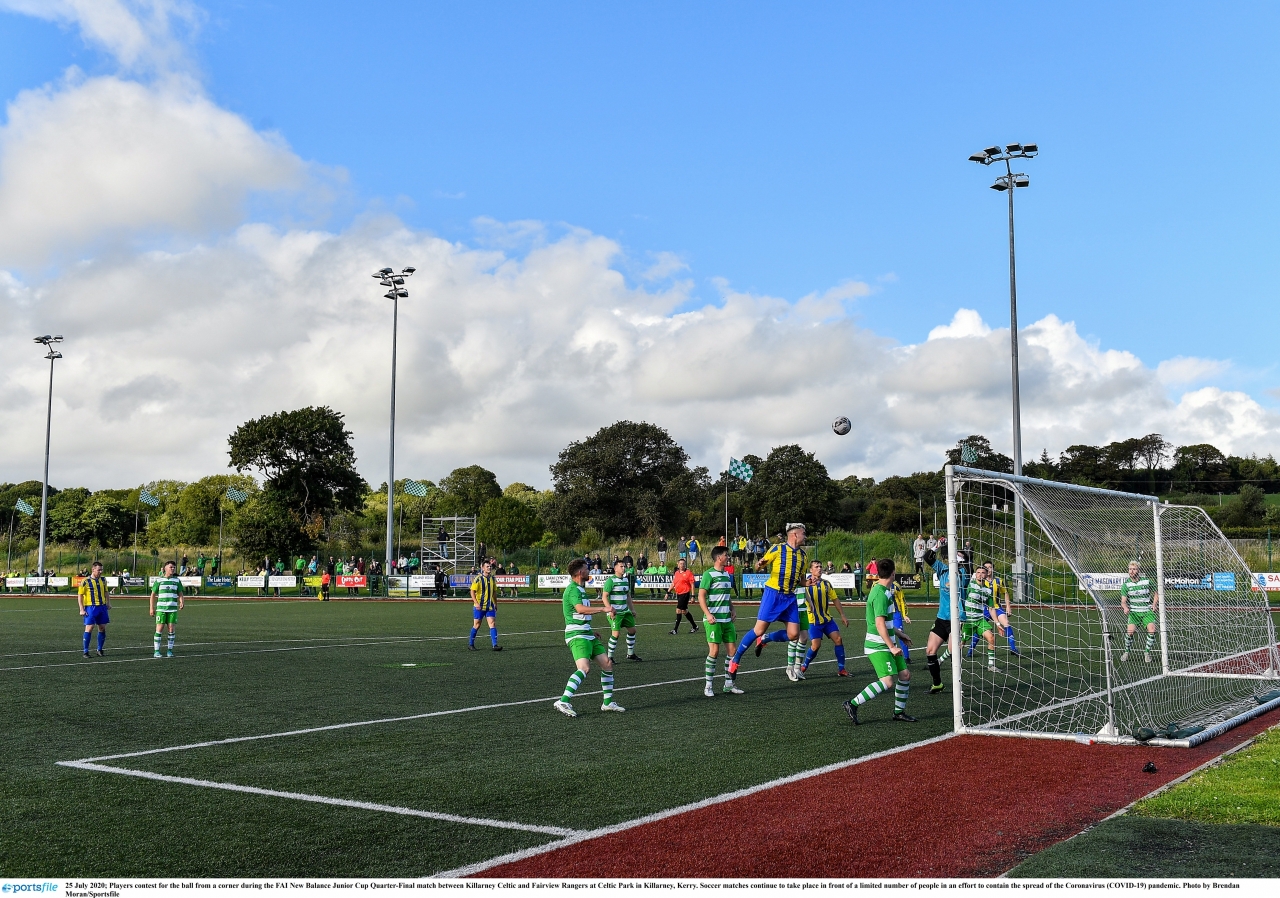
EF: Killarney Celtic are invited to participate in an Irish competition. That has big financial implications for travel, meals, etc.
MD: It is great to be invited, showing the quality of our squads, but travel costs are very high. I have been looking at clubs like ours in Limerick, Tipperary, Clare and elsewhere for a regionalised competition so that travel costs could be reduced, but I don’t see any commitment to that idea. It’s up in the air at the moment.
EF: Running an amateur sports club is very expensive, especially if you have so many successful teams in competition.
MD: You are well aware of that yourself, but with all of our activities, we are funded by the usual sources used by all sports to collect money. We are in a very good financial state.
EF:How good?
MD: As a trustee of the club, I am very proud to say that we are almost debt-free and we expect to be clear of any debt by October this year, marking our 50th anniversary. In saying that, whether you are an Under 12 or a senior player, all you have to pay for a training session with Killarney Celtic is €2.

EF:The women in Celtic appear to do great work developing soccer for all.
MD: Yes, they do marvellous work in so many parts of the club, led by trojan worker Mary Lyne. On Wednesday night last, the Mothers, Others and Friends started a weekly non-competitive fun game under lights at Celtic Park, and that is great.

EF: Can, can you see some ex-Celtic player is going to make it with a top Irish club and then cross Channel?
Md: I have to compliment Killarney Athletic here right away because Brendan Moloney and Diarmaid O’Carroll did just that. We haven’t had any such shining light yet, but we know that we will in the future because we have great young successful players coming through.
EF: Reverting back again, to 1976, you would have come up at the time The ‘ban’ was abolished. That rule prevented GAA players from playing soccer. If they did, they were suspended. However, it must have been difficult for a player to play both codes when it was permitted.
MD: Fair dues to Seán Kelly, he removed the “ban’, and we were very fortunate that there were some great players from Spa in particular, like Billy Morris, Seán Cronin, the Cahill brothers, James and John, Seánie Kelliher and others. They wanted to play football and soccer. The way we worked it in Celtic was that if the football season was over, then they always played soccer with us, and vice versa
EF: Why do you think that club soccer has become so popular in Ireland? It is climbing the rankings as a sport in Ireland.
MD: Because it’s on television the whole time, and the coverage is getting is precedented. Anytime you turn on the TV, you will find a soccer game from all parts of the world, not just cross channel. The 11-a-side is probably easier to organise than we say 15-a-side in the GAA, and some small clubs, particularly in rural areas, find it hard to get 15 to form a team. See what they’re doing in places. Two neighbouring teams get together as one team, and that’s understandable because all people want to do is play. Of course, not all young people wish to play soccer; they have different hobbies, learning the guitar or whatever, and that is great for them. That’s my experience anyway.

EF: The real crunch time comes when they get to roughly 18-years-old, completing their post-primary education and moving away from Killarney for third-level education. They may be in college, anywhere in the country, making it difficult to come down and play with their local club. So that’s one big reason for the fall off.
MD: Some fall away before that, believe it or not.
EF: Do you think Celtic are doing well, promoting the club?

Yes, for all sexes, but particularly for the girls, so that they can stay on longer for valuable coaching. We’re very fortunate to have David McIndoe as coach for the Celtic girls, and he is outstanding, absolutely fantastic.
EF: The FAI seems to stumble from one crisis to another, but at local level soccer is alive and well in towns, as well as in rural areas. Ballyhar and Mastegeeha are very good examples where great facilities have been developed by enthusiastic volunteers and that attracts the players
MD: So I think once you get to the stage where you have a facility and committed club people, you’re there. We have a very good membership, and we’d be well organised for parents who support their kids playing, and they do. We have two stands, as you know, one dedicated to our former great Celtic man, John Doyle (RIP). That’s important nowadays that you have a clubhouse where the spectators can get that welcome cup of coffee they will relish, especially on cold days.
EF: Where do you see Celtic in 2076?

MD: As I said earlier in Killarney Celtic, we are welcoming for everyone, the local Irish, of course, but it’s open to all. We have great people originally, from China, Europe, and the Middle East. We have an exceptionally good committee at the moment. We had people with foresight like Dermot O’Callaghan (RIP), who were progressive, and of course, that family continues the Celtic tradition. Obviously, we like to push the thing on a bit further, but we’re very conscious that we spent 50 years putting this together and we want to make sure that when we go, the structures are in place in (Killarney) Celtic for the next 50 ( years)As a trustee I am very proud of how we have developed and will celebrate that achievement this year. We will also remember the Celtic players and supporters who have passed away since 1976 and look forward to whatever challenges and opportunities face Killarney Celtic in the years ahead. It is hard to believe that it all started from our conversation (with Billy Healy and Tommy O’Shea) that a new club was needed in Killarney, so that all players who wish to play soccer will be able to play at whatever level they wish and join us at Celtic Park.
EF: Thanks, Mikey, and wish you good health on your daily cycles with your good friend Mike O’Neill.
That’s Mikey Daly, always a pleasure to chat with him on a variety of sports.

Continue Reading

News

LUKE MANGAN recently caught up with Kerry FC’s manager, Colin Healy. 

  He spoke to him about his careers as a player and manager. Here’s how it went: When you began your career, was there ever a player or manager you idolised? […]

Published

on


He spoke to him about his careers as a player and manager.

Here’s how it went:

When you began your career, was there ever a player or manager you idolised?

‘When I started my career, not really, I was 18 with Celtic and you know a lot of good players were there. Henrik Larsson was one. It was more important for me to get to that level and stay at that level, and it was a great experience’.

Tell me how it felt to play for Ireland while Mick McCarthy was manager.

‘It was very good. I began working with him in the Irish camp, and then when I joined Sunderland he would have been the manager there. So he’s been fantastic’.

Looking back on your career, what are you most proud of?

‘I’m just proud as always that I had a long career, a lot of injuries aswell, so probably getting back from those injuries. Along with playing for Cork City and playing internationally for Ireland which is always a good thing’.

When you went into managing, was there ever a manager or manager’s style you idolised?

‘Well we had a few, obviously Martin O’Neil at Celtic, and of course he’s still coaching today. Martin was a very good man and a very good manager. So I’d probably say Martin’.

Describe to me what it felt like to represent your country at an international level.

‘Yea, it was probably the proudest day and one of the biggest achievements’.

This will be your first full season with Kerry, what would you like to being to the club?

‘We recruited well, we still look to bring in more players, but listen i just want to get us as far as we can and get higher up the table and improve on last year’.

What do you believe is Kerry’s strongest capability?

‘We’re still in pre-season so we got some good goals, there’s still some stuff we can improve on, but its still early doors for us. Obviously we got new players, and they need the type of time as the players that are here. So overall it was good to get into the next round (of the Munster Senior Cup), but as I say, we can always be better’.

Attachments

Continue Reading