
News
Budget 2023 is just plastering over the cracks


By Michael O’Connor
The Irish Budget has never been something I have paid too much attention to.

.

.
My day-to-day focus is predominantly on stock market moves, so it never bears too much relevance, but Budget 2023 certainly caught my attention.
It was set against a backdrop of surging energy prices, inflationary pressures, and a red-hot housing crisis. As one of the few European countries with a budget surplus to dip into, expectations were high.
On the surface, the Budget didn't disappoint. The €11 billion package had a little something for everyone. The massive package of once-off measures will go a long way toward supporting households and businesses this year.
But when you dig a little deeper, many of the measures are simply providing a short-term sugar rush, with little substance once the initial high wears off.
I get it; financial relief is crucial but adding more money into the economy so people can afford to function in a broken system is not a long-term solution.
Tax cuts have been proclaimed as 'counter inflation' measures but are more likely to fan the flames of inflation than eliminate the problem.
Inflation is created when too much money is chasing too few goods. With this in mind, inflation is tackled by reducing the amount of money in the economy or increasing the supply of goods within that economy. Tax cuts do the opposite.
By increasing the amount of money in the system through tax cuts, the government has seemed to double down on the viewpoint that money is both the cause and solution to all of life's problems.
Fuel to the fire
Sure, these tax cuts will help to curry favour from a political perspective, but from an economic standpoint, you are simply adding fuel to the fire.
Instead of addressing the systemic problems causing the Cost of Living Crisis, they have simply freed up more money so you can tolerate the intolerable price hikes a little longer.
Take housing, for example.
Paschal Donohoe described housing as the "central issue facing the country".
Undoubtedly there are some positives from a housing perspective in the Budget, but as the "central issue facing the country", it falls short.
A band-aid solution
The 'Rent Tax Credit', in particular, highlights the band-aid solution being applied here.
Renters will be entitled to a rental credit of €500 per year from 2022 onwards. On the surface, this is much-needed relief for renters, but in reality, it simply exacerbates the problem.
Without getting too into the weeds, in economics, you have something called the paradox of aggregation. If everyone gets the benefit, then nobody gets to feel the effects of that benefit because nobody is better off from a relative standpoint.
If you won the lotto in the morning, you would be unquestionably better off. However, if we all won the lotto in the morning, we would all be richer on an absolute level, but you would no longer be better off relative to your peers. Prices would simply increase to account for the higher levels of wealth in the system.
The same logic applies to the 'Rent Tax Credit'. Everyone gets it, so nobody benefits. It simply just provides another gear for landlords. You can now 'afford' to pay higher rents, allowing landlords to raise rents even further. This is not relief but a mechanism to support higher rental prices in the future masked as support for those caught in the rental crisis.
Rent control, short-term letting restrictions, widespread public housing initiatives, subsidies to incentive construction development, and removal of the endless planning regulations. These are solutions that alleviate the supply side of the problem over the long term.
Instead, the government continues to throw more money at the problem so we can 'justify' higher and higher prices.
Housing supply
In fact, in a bizarre move, they have now placed a 10% levy on concrete blocks. Environmental concerns aside, at a point where every possible step needs to be taken to incentivise construction development to increase the housing supply in the system, levies are being applied to increase the cost of building even further.
Maybe I'm being overly cynical here. Compared to the UK budget, the Irish offering is a heroic feat of financial prowess, but another short-term response to the newest crisis at our doorstep is not enough.
Long-term allocation of capital and resources to solve the complete supply/demand mismatch in the housing market, nationalisation of energy, and extensive healthcare reform are areas where the bulk of the budgetary surplus needs to be allocated.
Short-sighted
Constantly repeating or extending 'temporary measures' is far too short-sighted. We have already seen an economic contraction in Q1 2022. These contractions may continue as we stare down the barrel of a recession in Europe. The budget surplus won't always be there.
When it is, we must prioritise long-term investments focused on solving systemic issues. Plastering over the cracks and hoping that the foundations stay intact until the next political party takes the wheel just isn't enough.

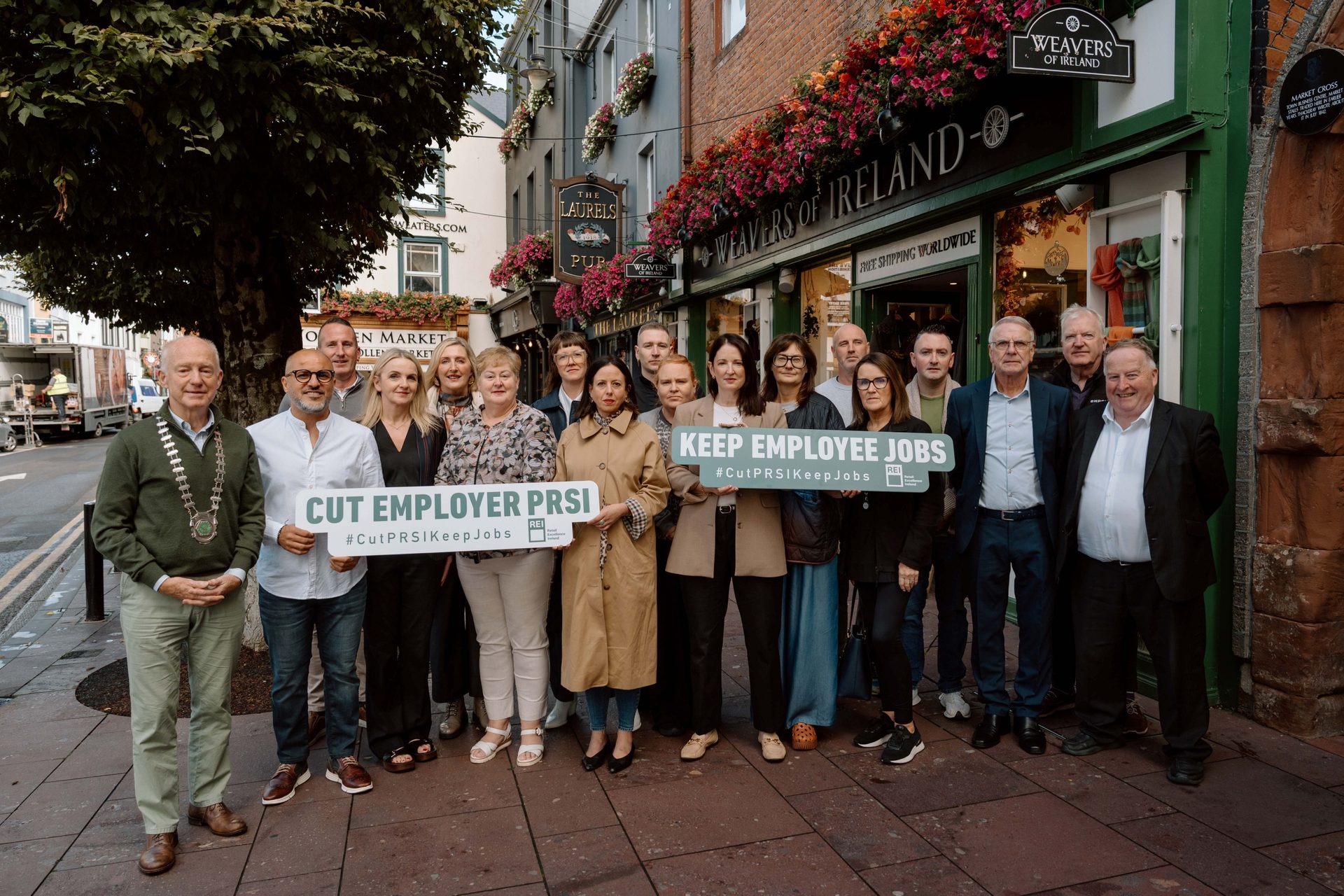
Retailers and shop staff across Killarney joined forces this week as part of the nationwide ‘#CutPRSIKeepJobs’ campaign, calling on the Government to reduce employers’ PRSI contributions in Budget 2027 to protect local employment.
Organised by Retail Excellence Ireland (REI), the campaign saw shop owners and employees stand together to highlight the severe financial pressures facing town centre businesses.
The industry body is urging the Government to introduce an employer PRSI band of 8% on the first €36,000 of every wage, zero employer PRSI for workers under 25, and a review of the methodology used to calculate the living wage.
The push comes amid growing concern over rising operational expenses, with new figures showing a loss of 10,800 retail jobs nationally over the past year and a 35% surge in retail insolvencies in the first half of 2026 alone.
Jean McCabe, Chief Executive Officer of Retail Excellence Ireland, warned that mounting wage costs are placing unprecedented strain on independent traders across Kerry.
“The retail industry has been under the most intense pressure from a range of cost pressures in recent times – and wage costs are the primary issue,” Ms McCabe said. “The industry is now seeing a rapid increase in insolvencies because of these pressures, so Government must now act unless it wants to see more businesses fail. Retailers standing together today shows just how widely this is being felt, in towns right across the country.”
Ms McCabe added that incoming PRSI rate increases scheduled for October 1 will deliver another major blow to small and medium enterprises unless urgent intervention is taken in the upcoming budget.
“We’re asking every TD, in every constituency, to back this ask,” Ms McCabe added. “And we’re asking Tánaiste Simon Harris, as Minister for Finance, to introduce it directly in Budget 2027. It’s costed, it’s modest, and it keeps jobs in local communities.”
Retailers join national campaign to cut PRSI and safeguard local jobs
Retailers and shop staff across Killarney joined forces this week as part of the nationwide ‘#CutPRSIKeepJobs’ campaign, calling on the Government to reduce employers’ PRSI contributions in Budget 2027 to protect local employment.
Organised by Retail Excellence Ireland (REI), the campaign saw shop owners and employees stand together to highlight the severe financial pressures facing town centre businesses.
The industry body is urging the Government to introduce an employer PRSI band of 8% on the first €36,000 of every wage, zero employer PRSI for workers under 25, and a review of the methodology used to calculate the living wage.
The push comes amid growing concern over rising operational expenses, with new figures showing a loss of 10,800 retail jobs nationally over the past year and a 35% surge in retail insolvencies in the first half of 2026 alone.
Jean McCabe, Chief Executive Officer of Retail Excellence Ireland, warned that mounting wage costs are placing unprecedented strain on independent traders across Kerry.
“The retail industry has been under the most intense pressure from a range of cost pressures in recent times – and wage costs are the primary issue,” Ms McCabe said. “The industry is now seeing a rapid increase in insolvencies because of these pressures, so Government must now act unless it wants to see more businesses fail. Retailers standing together today shows just how widely this is being felt, in towns right across the country.”
Ms McCabe added that incoming PRSI rate increases scheduled for October 1 will deliver another major blow to small and medium enterprises unless urgent intervention is taken in the upcoming budget.
“We’re asking every TD, in every constituency, to back this ask,” Ms McCabe added. “And we’re asking Tánaiste Simon Harris, as Minister for Finance, to introduce it directly in Budget 2027. It’s costed, it’s modest, and it keeps jobs in local communities.”
Retailers and shop staff across Killarney joined forces this week as part of the nationwide ‘#CutPRSIKeepJobs’ campaign, calling on the Government to reduce employers’ PRSI contributions in Budget 2027 to protect local employment.
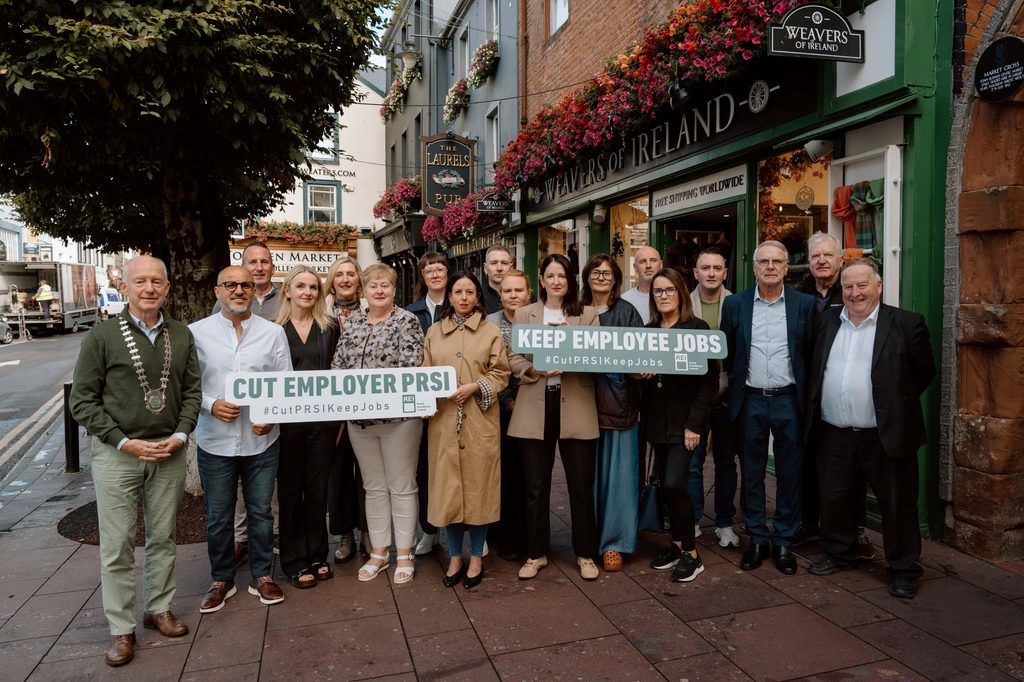
Organised by Retail Excellence Ireland (REI), the campaign saw shop owners and employees stand together to highlight the severe financial pressures facing town centre businesses.
The industry body is urging the Government to introduce an employer PRSI band of 8% on the first €36,000 of every wage, zero employer PRSI for workers under 25, and a review of the methodology used to calculate the living wage.
The push comes amid growing concern over rising operational expenses, with new figures showing a loss of 10,800 retail jobs nationally over the past year and a 35% surge in retail insolvencies in the first half of 2026 alone.
Jean McCabe, Chief Executive Officer of Retail Excellence Ireland, warned that mounting wage costs are placing unprecedented strain on independent traders across Kerry.
“The retail industry has been under the most intense pressure from a range of cost pressures in recent times – and wage costs are the primary issue,” Ms McCabe said. “The industry is now seeing a rapid increase in insolvencies because of these pressures, so Government must now act unless it wants to see more businesses fail. Retailers standing together today shows just how widely this is being felt, in towns right across the country.”
Ms McCabe added that incoming PRSI rate increases scheduled for October 1 will deliver another major blow to small and medium enterprises unless urgent intervention is taken in the upcoming budget.
“We’re asking every TD, in every constituency, to back this ask,” Ms McCabe added. “And we’re asking Tánaiste Simon Harris, as Minister for Finance, to introduce it directly in Budget 2027. It’s costed, it’s modest, and it keeps jobs in local communities.”

Retailers join national campaign to cut PRSI and safeguard local jobs
Retailers and shop staff across Killarney joined forces this week as part of the nationwide ‘#CutPRSIKeepJobs’ campaign, calling on the...

European mixology elite heading to Pig’s Lane
Fresh off being named Ireland’s Bar of the Year 2026, Pig’s Lane is set to host world-renowned Athens cocktail destination...


WEEK 14: Felicity’s Summer in Killarney
WEEK 14Felicity’s Summer in Killarney Previously: Here on Dundag it was far easier to relax than anywhere else. They had...

Frustration mounts over morning gridlock at Coolcorcoran
Frustration mounts over morning gridlock at Coolcorcoran Mounting traffic gridlock at the Coolcorcoran junction onto the N22 Killarney Bypass is...


Ailbhe Keogan scoops top television writing award
Acclaimed Kerry screenwriter Ailbhe Keogan has won the Best TV Drama Script award at the 19th Writers’ Guild of Ireland...


Fossa Swimmers make a splash at County Finals
The Fossa Swim team pictured at the Tralee Sports Complex following their successful outing at the County Finals of the...

On the Ball Part 2 of the Mikey Daly Interview
Éamonn Fitzgerald EF: Killarney Celtic are invited to participate in an Irish competition. That has big financial implications for travel,...


LUKE MANGAN recently caught up with Kerry FC’s manager, Colin Healy.
He spoke to him about his careers as a player and manager. Here’s how it went: When you began your...


Home cup tie for St Paul’s could be epic
Paudie O’Connor National Cup (Round 1) Utility Trust St Paul’s v GCU Brunell Saturday 7.30pm Killarney Sports and Leisure Centre...


Chances of Kerry v Cork Munster final in 2026 decrease as Munster GAA delay seeding plan
After facing a backlash from Limerick, Clare, Waterford and Tipperary players, Munster GAA have postponed their plan to keep Cork...
