
News
KNOW YOUR RIGHTS: One-Parent Family Payment


Q: What is the One-Parent Family Payment?
A: The One-Parent Family Payment (OFP) is a payment for men and women under 66 who are bringing children up without the support of a partner. To get OFP your children must be under a certain age.
You can work and get OFP. However, to get OFP your income must be below a certain amount.
Q: How does one qualify for the One-Parent Family Payment?
A: To qualify for the One-Parent Family Payment (OFP) you must:
* Be aged under 66
* Be the parent, step-parent, adoptive parent or legal guardian of a child under a certain age.
* Be the main carer of at least one child under the age limit. The child must live with you. OFP is not paid if the parents have joint equal custody of a child or children.
* Pass a means test – this looks at any income that you have
* Live in Ireland and meet the habitual residence condition
* Not be living with a spouse, civil partner or cohabiting
Q: What is the age limit for a child?
Q: To get the One-Parent Family Payment (OFP) you must have at least one child under seven years of age. You may get OFP for a child aged seven or over if you are getting Domiciliary Care Allowance, half-rate Carer's Allowance or Blind Pension or after the death of a spouse, partner or civil partner.
Q: What happens when my child is over the age limit?
A: Your OFP will stop when your youngest child reaches the age limit. The Department of Social Protection (DSP) will inform you of the end date for your payment. You may get the Jobseeker's Transitional Payment. This is a payment for people parenting alone whose children are aged between seven and 13. You can get information and advice about your options from your local Social Welfare Branch Office or Citizens Information Centre.
Q: How is my income from work treated in the means-test for OFP?
A: The first €165 of your gross weekly earnings (wages and profit from self-employment) is not taken into account in the means test. Half the remainder of your gross earnings per week is assessed as means and you may get a reduced rate of OFP. Social insurance contributions, superannuation/PRSA contributions and trade union subscriptions are not taken into account when calculating your gross earnings. You can contact your local Citizens Information Centre or Social Welfare office for advice on how your income from work would impact the level of OFP you can receive.
Q: How will the maintenance I receive be treated in the means test for OFP?
A: Maintenance payments for you and maintenance to you for any of your children is assessed in the means test. If you are getting maintenance from more than one person, all the payments are added together and the total is assessed. However, only half of your income from maintenance will be deducted from your OFP.
If you have housing costs, your rent or mortgage repayment up to a maximum of €95.23 per week can be offset against maintenance payments. Half the balance is then assessed as means. You must provide proof of rent or mortgage payments.
Q: Can I receive OFP if I decide to go to college?
A: You can keep your One-Parent Family Payment (OFP) if you are in education. You may have the option to transfer to the Back to Education Allowance (BTEA) or to stay on your current payment and apply for a student grant. You can contact your local Citizens Information Centre or Social Welfare office for advice on which option is of greatest benefit to you. You cannot get BTEA and a student grant together.
For anyone needing information, advice or have an advocacy issue, you can call a member of the local Citizens Information team in Kerry on 0818 07 7860, they will be happy to assist and make an appointment if necessary. The offices are staffed from Monday to Friday from 10am to 4pm. Alternatively you can email tralee@citinfo.ie or log on to www.citizensinformation.ie for further information.

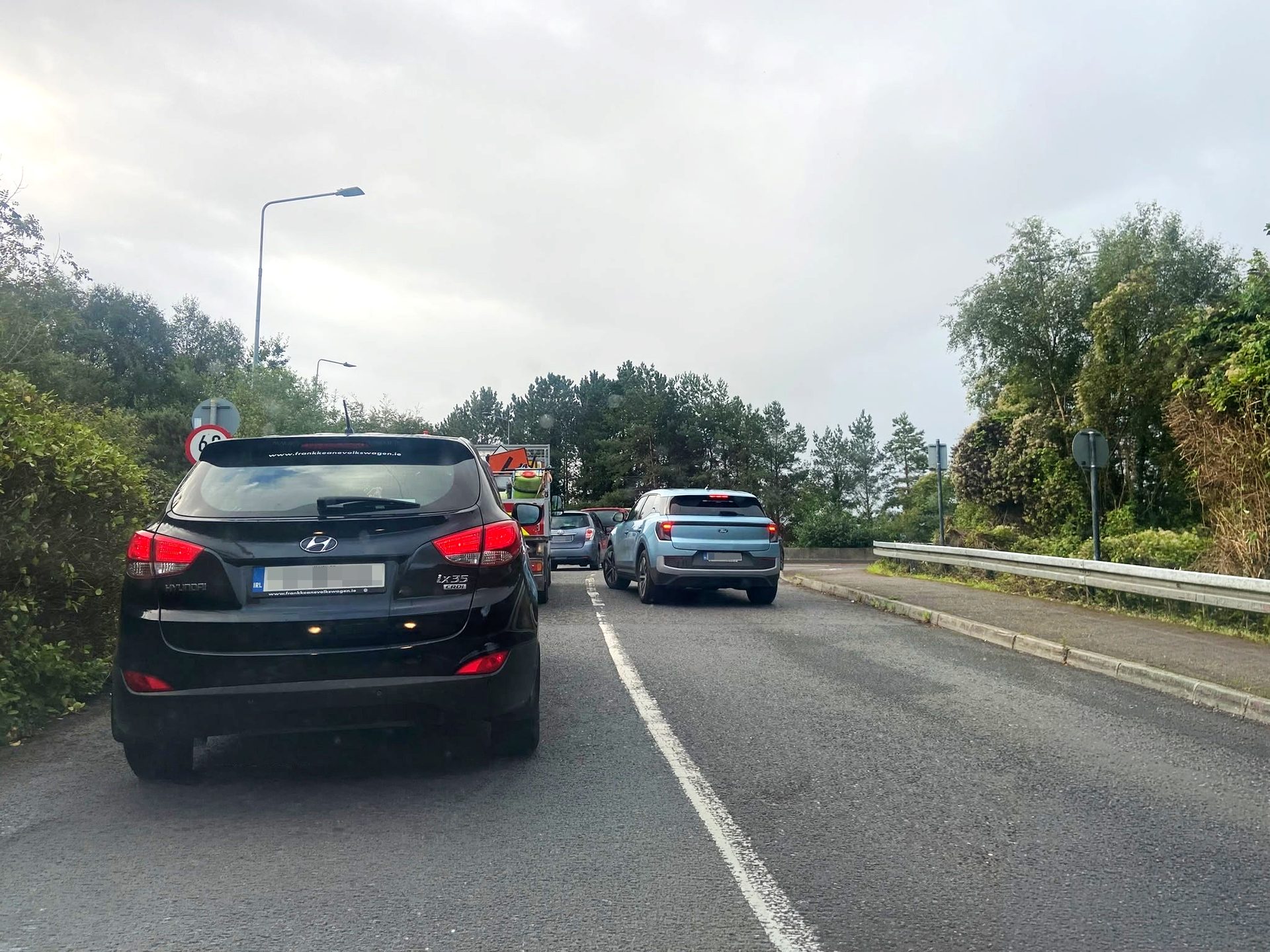
Frustration mounts over morning gridlock at Coolcorcoran
Mounting traffic gridlock at the Coolcorcoran junction onto the N22 Killarney Bypass is causing daily delays for commuters, with local motorists calling on Killarney Municipal District and elected representatives to take immediate action.
Early morning traffic coming from the Tralee side has become severely backed up past BG Motors during the peak 8.15am commute.
Motorists attempting to enter the bypass from the Coolcorcoran side face long queues and increasing frustration as they struggle to join the main road.
Local drivers point to a specific design issue at the exit, where a raised kerb and a section of unused footpath prevent left-turning vehicles from merging smoothly into the traffic flow.
Road users are requesting a simple layout modification to resolve the bottleneck: converting the exit to left-turn only, removing the kerb obstruction, and directing driver traffic to loop via a U-turn at the Killarney Sports and Leisure Centre roundabout. Similar left-turn measures were previously implemented at the nearby Lewis Road junction to improve safety and traffic flow.
The request comes as broader plans for the N22 bypass upgrade and new link road infrastructure remain under progression by Kerry County Council and Transport Infrastructure Ireland.
Motorists wishing to share their views on local road issues can email info@killarneyadvertiser.ie.


Frustration mounts over morning gridlock at Coolcorcoran
Frustration mounts over morning gridlock at Coolcorcoran Mounting traffic gridlock at the Coolcorcoran junction onto the N22 Killarney Bypass is...


Ailbhe Keogan scoops top television writing award
Acclaimed Kerry screenwriter Ailbhe Keogan has won the Best TV Drama Script award at the 19th Writers’ Guild of Ireland...


Strong turnout for St Paul’s Golf Classic at Beaufort
After a recent spell of indifferent weather, glorious sunshine and a gentle breeze greeted 35 teams at Beaufort Golf Course...


€150,000 granted to draft masterplan for St Finan’s site
Kerry County Council has been awarded €150,000 in government funding to progress a Masterplan and Infrastructure Delivery Plan for the...

GoSafe cameras live at Farranfore level crossing next week
GoSafe cameras live at Farranfore level crossing next week Automated speed cameras at the Farranfore rail level crossing will become...


Fossa Swimmers make a splash at County Finals
The Fossa Swim team pictured at the Tralee Sports Complex following their successful outing at the County Finals of the...
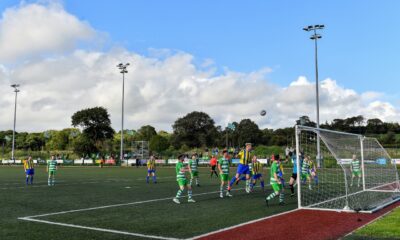

On the Ball Part 2 of the Mikey Daly Interview
Éamonn Fitzgerald EF: Killarney Celtic are invited to participate in an Irish competition. That has big financial implications for travel,...


LUKE MANGAN recently caught up with Kerry FC’s manager, Colin Healy.
He spoke to him about his careers as a player and manager. Here’s how it went: When you began your...


Home cup tie for St Paul’s could be epic
Paudie O’Connor National Cup (Round 1) Utility Trust St Paul’s v GCU Brunell Saturday 7.30pm Killarney Sports and Leisure Centre...


Chances of Kerry v Cork Munster final in 2026 decrease as Munster GAA delay seeding plan
After facing a backlash from Limerick, Clare, Waterford and Tipperary players, Munster GAA have postponed their plan to keep Cork...
