
News
KNOW YOUR RIGHTS: Small Claims Procedure


Q: What is the purpose of the Small Claims Procedure?
The aim of the Small Claims Procedure (also known as the Small Claims Court) is to provide an inexpensive, fast and easy way for consumers and businesses to resolve disputes without the need to employ a solicitor. Both the person making the claim (the claimant) and the respondent (the person you are claiming against) must be living or based within the State. If either party lives or is based in another EU member state, the European Small Claims Procedure should be used. The small claims procedure is provided by the local District Court offices.
What kind of issues are dealt with through the Small Claims Procedure?
The following types of consumer claims can be dealt with under the Small Claims Procedure:
* Consumer claims such as for faulty goods or bad workmanship. You must have bought the goods or service for private use from someone selling them in the course of business. Claims can also be made for minor damage to your property.
* Claims for the non-return of a rent deposit for certain kinds of rented properties, such as, a holiday home or a flat in a premises where the landlord also lives.
* The claim cannot exceed €2,000.
Are there some consumer claims not covered by the Small Claims Procedure?
Consumer claims cannot be made through the Small Claims Procedure for debts, personal injuries or breach of leasing or hire-purchase agreements.
Is there a fee for making a claim?
The current fee for making a claim through the Small Claims Procedure is €25. This fee is payable by cheque (made out to the Small Claims Registrar) or postal order. The Small Claims Registrar will accept the fee in cash if you pay it in person. If you apply online, you are required to pay online. If your claim is accepted as suitable for the Small Claims Procedure the fee is not refunded, even if your claim is successful.
How do I apply to have a claim dealt with by the Small Claims Procedure?
You can access detailed guidance on how to apply to the Small Claims Registrar on the Courts Service website www.courts.ie. You can print an application for the Small Claims Procedure from the website. This application form is also available from your local Citizens Information Centre or from the local District Court offices. Staff in the District Court office can help in completing the application form. It is important when completing the application form to give all the necessary information. This will help the Small Claims Registrar to process your claim and try and resolve the dispute. If no resolution can be reached, it will also make it easier to enforce a Decree (or court order) if one is granted. You can also make an application for the Small Claims Procedure online. Using Courts Service Online you can create and pay for a small claim application. You can also check the status of your online small claim securely, using a username and password. To create a claim online you need a credit or debit card and an email address to which you have access.
Where do I apply?
The Small Claims Procedure is provided through local District Court offices. You make your claim to the District Court office in the area either where:
* The person you are making a claim against lives or carries on business
* Where the contract was made
* Where the damage to property took place
You will find a list of District Court areas on the Court Service website.
What is the European Small Claims Procedure?
The European Small Claims Procedure provides an inexpensive and easy way for someone to pursue a cross-border claim without the need to employ a solicitor. Similar to the Small Claims Court it can be used in civil and in commercial matters. The claim cannot exceed €5,000. It is an alternative to other options that may exist under the national laws of EU member states.
The fee for the European Small Claims Procedure is €25. You may have to pay for the translation of your documents if they are in a language the defendant does not understand. If you win you can claim for such additional costs. If you lose, however, you may have to pay for any translation or other costs incurred by the defendant.
What cases does it apply to?
The procedure applies to cross-border cases. In other words, the party with whom you are in dispute must be domiciled or habitually resident in another member state and you are pursuing the action in Ireland. It allows you, for example, to make a claim in Ireland for a faulty product which you bought online from someone living in another EU country.
How do I apply to the European Small Claims Procedure?
European Small Claims Procedure claim forms are available from your local District Court office. You cannot make a claim online but can download the claim form from the Courts Service website www.courts.ie. You must complete the form, giving details of your claim, the amount you are seeking and any other details required. You must give the name and full physical address of the party you are in dispute with, even if it is an online business.
The completed claim form together with any supporting documentation and the fee must be lodged with the Registrar in the local District Court office.
For more detailed information on the Small Claims Procedure and European Small Claims Procedure, you can call a member of the local Citizens Information Service in Kerry on 0818 07 7860. The telephone lines are staffed from 10am to 4pm from Monday to Friday. The National Phone Service is available on 0818 07 4000 Monday to Friday 9am to 8pm.
Alternatively, you can email on tralee@citinfo.ie or log on to www.citizensinformation.ie.


A design team has been appointed to advance plans for the proposed Minor Injury Unit on the grounds of St Columbanus Home though the HSE has confirmed it cannot yet give a construction or opening timeline.
Fianna Fáil TD Deputy Michael Cahill received the update in response to a Parliamentary Question submitted to the Minister for Health. HSE South West confirmed the newly appointed team will progress the project through design development, planning, and regulatory approval following the transfer of residents to the new Killarney Community Nursing Unit.
Deputy Cahill welcomed the appointment of the design team but raised concerns over the lack of a definitive schedule.
“I welcome the appointment of a design team, which represents progress towards delivering this important facility. However, I am concerned that the HSE is still unable to provide a definitive timeline. Previous indications from HSE officials pointed towards construction commencing in 2026, with completion anticipated in 2027. We now need clarity on the project schedule and assurances that there will be no unnecessary delays,” Deputy Cahill said.
He noted that the facility is vital to serve Killarney and the wider east, mid, and south Kerry regions while relieving pressure on the Emergency Department at University Hospital Kerry.
The HSE also confirmed it is finalising a broader review of healthcare accommodation across Killarney to develop the St Columbanus campus as an integrated healthcare hub.
“As a member of the Oireachtas Joint Committee on Health, I will continue to press the HSE and the Minister for Health to ensure this project is progressed without further delay. People across Killarney, east, mid, west and south Kerry deserve certainty. The appointment of a design team is welcome but the next priority must be getting this project to construction and delivering the facility,” Deputy Cahill concluded.
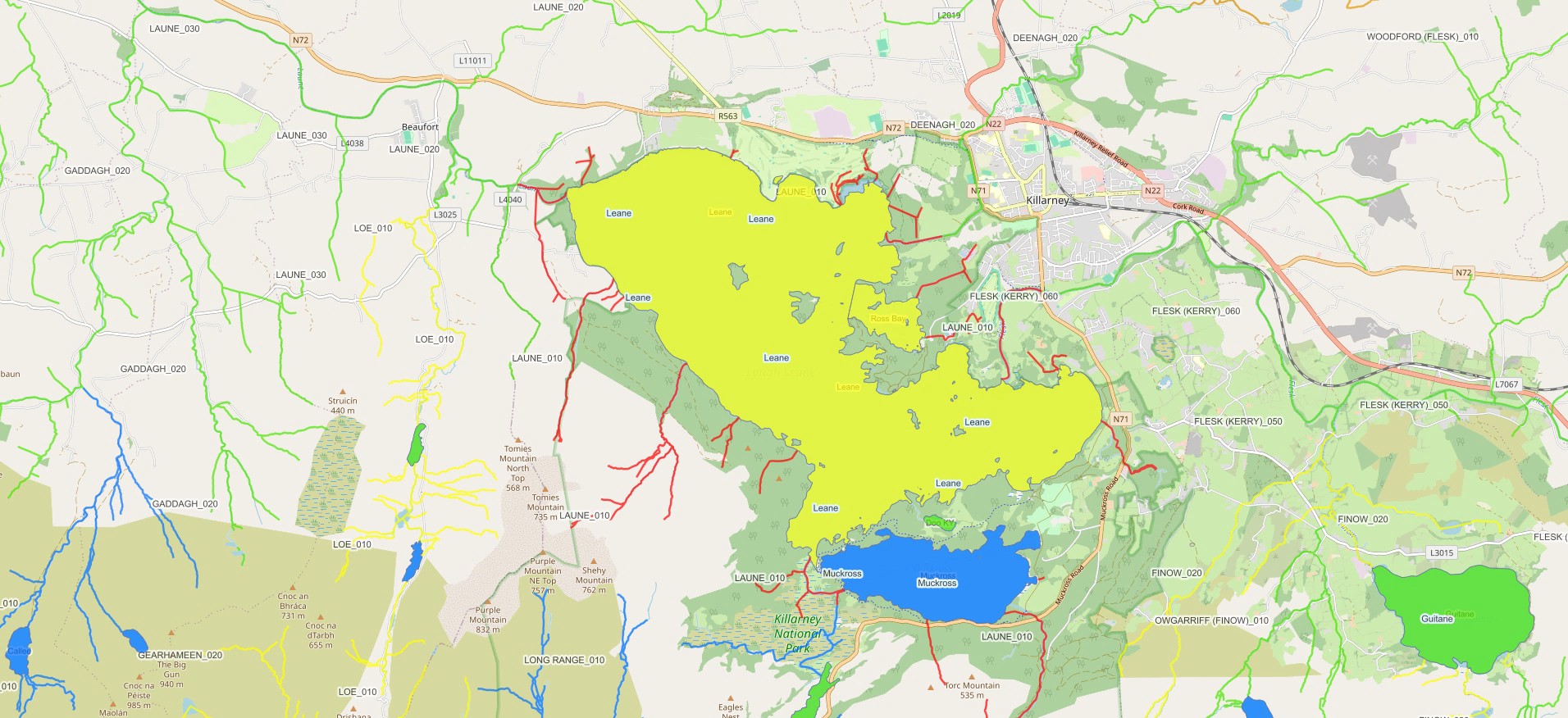
Lochanna Beo’s mapping highlights water quality concerns
Local environmental action group Lochanna Beo has released mapping data from the Environmental Protection Agency (EPA) to draw attention to deteriorating water quality across Killarney and the broader Laune Catchment.
The EPA map uses a colour-coded system to rate water quality status from 2019 to 2024: blue indicates high status, green indicates good, yellow represents moderate, brown denotes poor, and red signifies bad status.
The figures indicate significant ecological pressure on local lakes and rivers compared to neighbouring areas across County Kerry.
Formed during the summer of 2026, Lochanna Beo aims to bring together residents, business owners, agricultural operators, and public bodies to address the key factors affecting the regional aquatic ecosystem.
The community initiative is seeking direct engagement with relevant statutory authorities to implement practical restoration measures and protect the long-term health of Killarney’s water bodies.


Design team appointed for injury unit
A design team has been appointed to advance plans for the proposed Minor Injury Unit on the grounds of St...

Lochanna Beo’s mapping highlights water quality concerns
Lochanna Beo’s mapping highlights water quality concerns Local environmental action group Lochanna Beo has released mapping data from the Environmental...


Stefan Caulfield-Dreier signs professional cycling contract
Former Killarney Cycling Club rider Stefan Caulfield-Dreier has secured a professional contract with leading Dutch-based outfit Azerion-Villa Valkenburg. The 23-year-old...


Church seeks creative Christmas trees for festival
Church seeks creative Christmas trees for festival The Methodist Church in Killarney is inviting local schools, community groups, businesses, and...


€6,000 Scrooge Giveaway!
€6,000 Scrooge Giveaway! Six lucky audience members will each walk away with €1,000 as the Gleneagle Arena welcomes an extraordinary...


Fossa Swimmers make a splash at County Finals
The Fossa Swim team pictured at the Tralee Sports Complex following their successful outing at the County Finals of the...

On the Ball Part 2 of the Mikey Daly Interview
Éamonn Fitzgerald EF: Killarney Celtic are invited to participate in an Irish competition. That has big financial implications for travel,...


LUKE MANGAN recently caught up with Kerry FC’s manager, Colin Healy.
He spoke to him about his careers as a player and manager. Here’s how it went: When you began your...


Home cup tie for St Paul’s could be epic
Paudie O’Connor National Cup (Round 1) Utility Trust St Paul’s v GCU Brunell Saturday 7.30pm Killarney Sports and Leisure Centre...


Chances of Kerry v Cork Munster final in 2026 decrease as Munster GAA delay seeding plan
After facing a backlash from Limerick, Clare, Waterford and Tipperary players, Munster GAA have postponed their plan to keep Cork...
