
News
Buy what you believe in


During a recent pitch, one of the attendees asked me, "What should I do with my savings right now" which is a reasonable question to ask a guy who spends his days studying financial markets, right?
You would think this would be a simple question to answer, but I have been at this for nearly a decade now, and I still haven't quite perfected the most frequently asked question. Unfortunately, there is no one-size-fits-all when it comes to investing. How I answer this question will ultimately depend on the individual's experience, finances, time horizon and risk tolerance.
But of course, starting my answer with "it depends" was likely to be met with uncontrollable eye-rolling and unbridled verbal abuse, so in an attempt to appease the angry mob (my recollection may or may not be somewhat exaggerated for dramatic effect), I neatly condensed what he needed to do into one simple sentence.
Buy great companies and hold them for a long time. That's it.
In reality, investing can be much more nuanced, but this is essentially the framework that all future investment plans should be built upon - the foundations of sound investing. No complex math, no fancy credentials required, just common sense, optimism, and a lot of patience.
While I wish that I had the ability to conveniently pack the intricacies of investing into just one 10-word quip, the above sentence is rendered useless if you have no idea how to identify great businesses, so let's dive a little deeper.
Finding great companies can be as simple as opening your eyes. Your fridge. Your wardrobe. Behind virtually every successful product or service lies a publicly-traded company that's cashing in on that success. Through stock investing, you can join in on that success by purchasing a part of the company.
Many presume that stock picking is based solely on complex future cash flow calculations and ratio analysis. However, qualitative, common-sense metrics are just as, if not more important.
Here are some of the first questions I ask myself when analysing any business.
Will the company exist in 10 years?
This is the first question you should always ask yourself. If you can't answer this question with some degree of confidence, then it's time to look elsewhere.
Do I truly understand what the company does?
It's crucial to invest in companies you understand. If you do not have a solid understanding of how the company makes money, you will never have the conviction needed to hold it during the inevitable market dips.
Does the company have a competitive advantage?
When looking for a good investment, always look for a sustainable competitive advantage, a moat that will prevent competitors from entering the market and stealing market share. This protection can come in many forms, such as a strong brand, a patent advantage, network effects or proprietary IP.
There are hundreds of new startups emerging every day with new technologies that can threaten even the most established companies. Likewise, numerous mega-cap companies are looking to use their existing brand recognition and cash flow to penetrate new markets, take Amazon as an example.
It's not always enough to have a great business, without an adequate moat, a company is unlikely to survive over the long run.
Is the business part of a growing industry or sector?
What changes will we see globally over the next 20 years, and what companies will be at the forefront of these future megatrends?
Do you believe sustainable energy is the way of the future? Maybe you believe Robotics and Gene therapy trends will continue; autonomous vehicles are a given, and space tourism is on the horizon. Whatever your future view of the world is, you should focus your efforts on exploring companies that are set to profit from the societal shifts you believe in.
You'll find great investing ideas by reading up on the latest technologies and changing consumer trends but be warned; new technologies often get overhyped in the early stages. A more in-depth valuation analysis will be needed once you have identified these future industry leaders.
If you stumble across a company that ticks all these boxes, odds are, you're looking at a great candidate for your hard-earned savings.

A design team has been appointed to advance plans for the proposed Minor Injury Unit on the grounds of St Columbanus Home though the HSE has confirmed it cannot yet give a construction or opening timeline.
Fianna Fáil TD Deputy Michael Cahill received the update in response to a Parliamentary Question submitted to the Minister for Health. HSE South West confirmed the newly appointed team will progress the project through design development, planning, and regulatory approval following the transfer of residents to the new Killarney Community Nursing Unit.
Deputy Cahill welcomed the appointment of the design team but raised concerns over the lack of a definitive schedule.
“I welcome the appointment of a design team, which represents progress towards delivering this important facility. However, I am concerned that the HSE is still unable to provide a definitive timeline. Previous indications from HSE officials pointed towards construction commencing in 2026, with completion anticipated in 2027. We now need clarity on the project schedule and assurances that there will be no unnecessary delays,” Deputy Cahill said.
He noted that the facility is vital to serve Killarney and the wider east, mid, and south Kerry regions while relieving pressure on the Emergency Department at University Hospital Kerry.
The HSE also confirmed it is finalising a broader review of healthcare accommodation across Killarney to develop the St Columbanus campus as an integrated healthcare hub.
“As a member of the Oireachtas Joint Committee on Health, I will continue to press the HSE and the Minister for Health to ensure this project is progressed without further delay. People across Killarney, east, mid, west and south Kerry deserve certainty. The appointment of a design team is welcome but the next priority must be getting this project to construction and delivering the facility,” Deputy Cahill concluded.
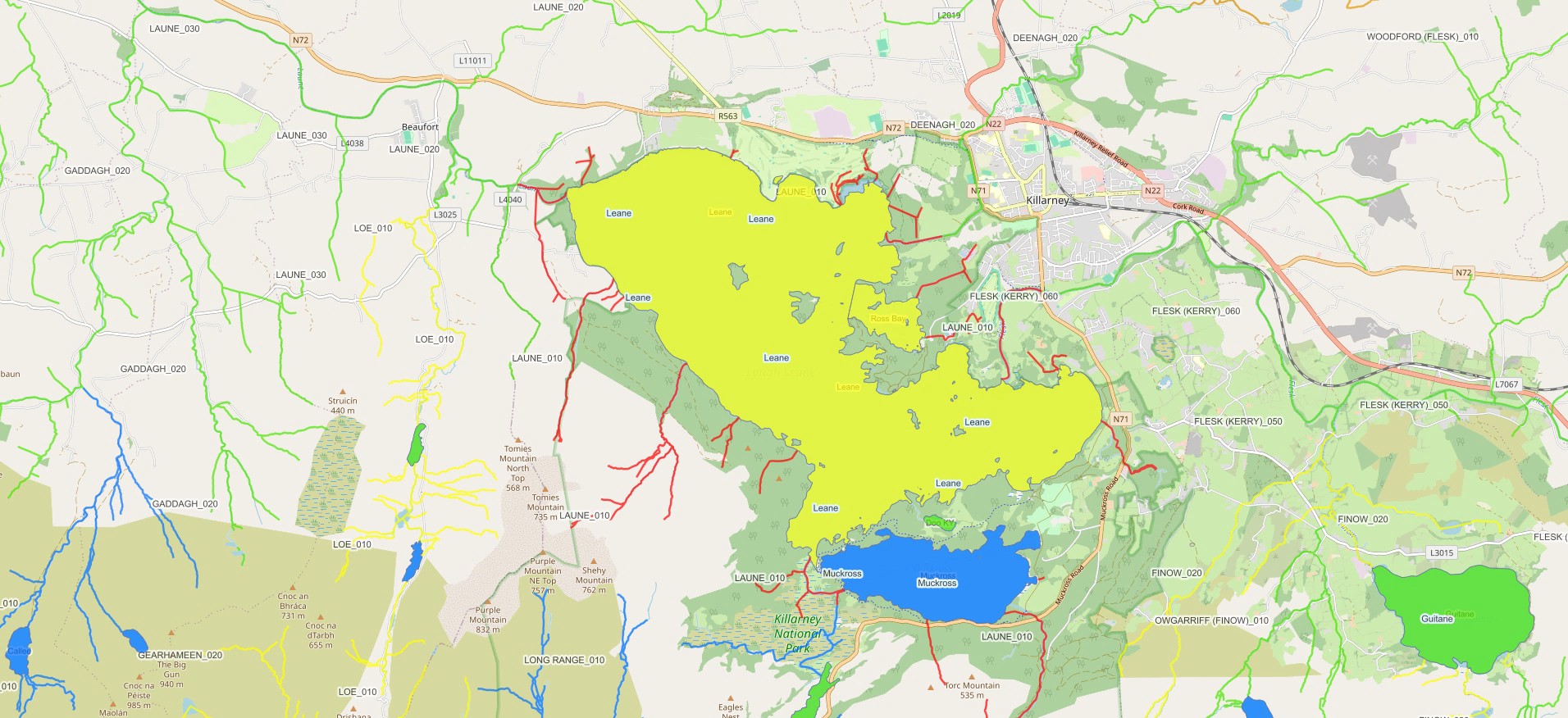
Lochanna Beo’s mapping highlights water quality concerns
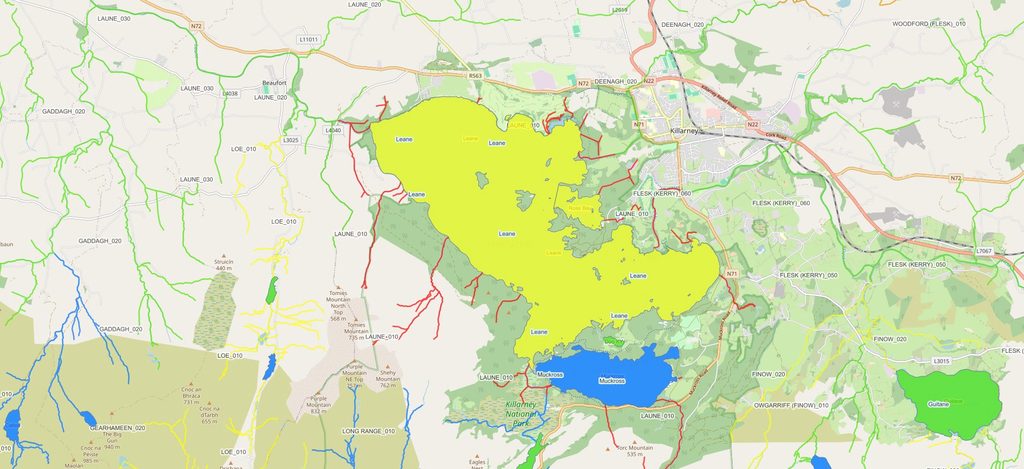
Local environmental action group Lochanna Beo has released mapping data from the Environmental Protection Agency (EPA) to draw attention to deteriorating water quality across Killarney and the broader Laune Catchment.
The EPA map uses a colour-coded system to rate water quality status from 2019 to 2024: blue indicates high status, green indicates good, yellow represents moderate, brown denotes poor, and red signifies bad status.
The figures indicate significant ecological pressure on local lakes and rivers compared to neighbouring areas across County Kerry.
Formed during the summer of 2026, Lochanna Beo aims to bring together residents, business owners, agricultural operators, and public bodies to address the key factors affecting the regional aquatic ecosystem.
The community initiative is seeking direct engagement with relevant statutory authorities to implement practical restoration measures and protect the long-term health of Killarney’s water bodies.


Design team appointed for injury unit
A design team has been appointed to advance plans for the proposed Minor Injury Unit on the grounds of St...

Lochanna Beo’s mapping highlights water quality concerns
Lochanna Beo’s mapping highlights water quality concerns Local environmental action group Lochanna Beo has released mapping data from the Environmental...


Stefan Caulfield-Dreier signs professional cycling contract
Former Killarney Cycling Club rider Stefan Caulfield-Dreier has secured a professional contract with leading Dutch-based outfit Azerion-Villa Valkenburg. The 23-year-old...


Church seeks creative Christmas trees for festival
Church seeks creative Christmas trees for festival The Methodist Church in Killarney is inviting local schools, community groups, businesses, and...


€6,000 Scrooge Giveaway!
€6,000 Scrooge Giveaway! Six lucky audience members will each walk away with €1,000 as the Gleneagle Arena welcomes an extraordinary...


Fossa Swimmers make a splash at County Finals
The Fossa Swim team pictured at the Tralee Sports Complex following their successful outing at the County Finals of the...


On the Ball Part 2 of the Mikey Daly Interview
Éamonn Fitzgerald EF: Killarney Celtic are invited to participate in an Irish competition. That has big financial implications for travel,...


LUKE MANGAN recently caught up with Kerry FC’s manager, Colin Healy.
He spoke to him about his careers as a player and manager. Here’s how it went: When you began your...


Home cup tie for St Paul’s could be epic
Paudie O’Connor National Cup (Round 1) Utility Trust St Paul’s v GCU Brunell Saturday 7.30pm Killarney Sports and Leisure Centre...


Chances of Kerry v Cork Munster final in 2026 decrease as Munster GAA delay seeding plan
After facing a backlash from Limerick, Clare, Waterford and Tipperary players, Munster GAA have postponed their plan to keep Cork...
